
In January 2023 the Bushfire and Natural Hazards Cooperative Research Centre (BNHCRC) released a tranche of reports related to the Black Summer fires (2019-2020). One of these was Investigating the suitability of aviation tracking data for use in bushfire suppression effectiveness research. Researchers from the University of Wollongong, CSIRO and the BNHCRC analysed the airdrop data available from NSW and crunched it various ways to see how useful it was and what they could extract from the data about effectiveness. This proved difficult.
The authors list the multiple inquiries that have called for research into the effectiveness of firefighting aircraft – a research blind spot. The BNHCRC report adopted terminology from a pioneer US project on Aerial Firefighting Use and Effectiveness, which was prompted by ongoing US government frustration over the cost of aerial firefighting and the lack of evaluation. To assess the effectiveness of aerial drops, the US project used five objectives (eg. initial attack, property protection) and seven outcomes (eg. the drop delayed fire spread, protected assets successfully). However the nine-year, $US11 million project produced limited results.

Location tracking is mandated for all Australian firefighting aircraft, but only some are required to have firebombing event logging (drops and fills etc.). NSW data was lacking in many parameters:
- 60% of specialised bombing aircraft had no drop data, including at least two LATs, one being the RFS 737;
- 63 of 64 smaller aircraft (including 48 firebirds) also had no drop data;
- the actual drop product used (water, gel, foam, retardant) was missing in 70% of cases;
- drop volume was missing in 44% of cases;
- drop objectives were often not recorded.
Firebombing aircraft include large and medium helicopters, single engine air tankers (SEATs) and large air tankers (LATs).) To overcome some of the data shortfall, 10 experienced Air Attack Supervisors (AAS) from the NSW Rural Fire Service, NSW National Parks and Wildlife Service and British Columbia Wildfire Service were interviewed about specific Black Summer fire events they worked on in NSW. They were also asked: “What improvements could be made to data gathering or the reporting systems to improve our ability to learn” (page 35). They had many ideas and all supported a routine interview or survey of AAS after future bushfires.
The report includes eight case studies of “particular days at a particular part of a fire”, using both recorded data and information from interviewees. The case studies provide examples where aerial bombing was deemed effective, ineffective or inconclusive. The report emphasises that in the absence of information about on-ground activity and many other factors, assessing outcomes is problematic.
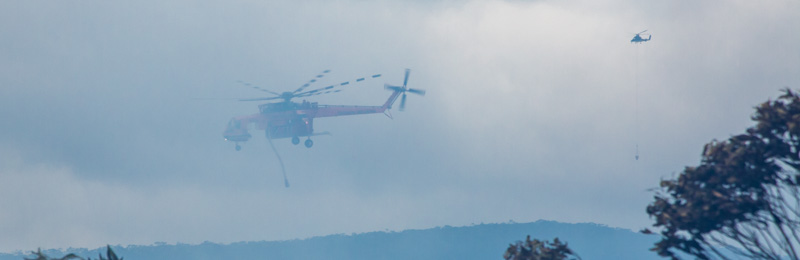
The paper also cites the cost of NSW aerial firefighting in Black Summer, which was $306.3 million. This included six LATs and VLATs (very large air tankers) dropping 24 million litres on 1708 missions (NSW Rural Fire Service, Royal Commission Into National Natural Disaster Arrangements, Notice & Summons to Give information NTG-HB2-209, pages 20-21).
The BNHCRC report found that: “…this data has the potential to facilitate comprehensive analyses of aerial firefighting effectiveness that were not previously possible. This work explored methods and case studies that could be expanded into comprehensive evaluation” (page 54). However the missing data “hamper learning and needs to be improved”.
The authors make a number of recommendations, including (page 55):
“There should be a routine interview or survey process for AAS after the bushfires…aimed at identifying objectives and outcomes”.
“Fire management agencies should create an evaluation database that summarises objectives, outcomes, the number and type of aircraft, drops, type and litres, and ancillary observations such as weather, resources available etc“.
“The next step would be to investigate the conditions associated with success or failure, including weather, size and behaviour of the fire, scale of the objective, amount of resources available, drop quantity and type etc. Ultimately, there should be research that examines the full context of aerial suppression, which includes how effective it is when combined with other types and amounts of suppression…”
(Investigating the suitability of aviation tracking data for use in bushfire suppression effectiveness research, page 55)
IBG comment
- This report yet again highlights the dearth and critical need for more bushfire suppression analysis and research, especially on firefighting strategies and effectiveness. This is a core focus for IBG’s work.
- The lack of adequate data on which to base analysis indicates a longstanding disinterest by fire agencies in learning from past operations, and a tragic lost opportunity from the important lessons that should have come out of Black Summer. There is little evidence that this situation is improving. IBG asserts NSW needs an independent Inspector General of Emergency Management to drive learning culture.
- Aerial operations are an essential and important part of bushfire suppression. But the massive cost is not matched by the evidence base to understand what works best and what doesn’t, especially for bombing work. Aircraft continue to be purchased and contracted without evaluation of the best mix of aircraft and the best use for each type of aircraft.
- The BNHCRC report recommendations and “next step” (quoted above) are strongly supported as essential to optimising the use of firefighting aircraft to reduce bushfire impacts.
“When a [US] federal agency spends more than half a billion dollars in a year on one activity such as fire aviation with very little meaningful oversight, it needs to have a robust knowledge base for making decisions about how to spend those taxpayer dollars.”
“In conditions like we have seen in recent decades, fire agencies, including those who mostly grow trees, should be extremely confident their aerial fleets are comprised of the most capable aircraft in adequate numbers so that all wildland fires that are being suppressed can be attacked from the air within the first 20 minutes, supporting firefighters on the ground. This is just basic Homeland Security.”
Bill Gabbert, writing in Fire Aviation (US online magazine), April 16 2021, on “What did we learn from the Aerial Firefighting Use and Effectiveness study?“
 Independent Bushfire Group