Planned burning is an important tool for mitigating bushfire risk in NSW, yet it lacks strategic policy guidance and ongoing assessment of how effective it is.
There are many questions around what the annual burning program does and whether it is reducing risk efficiently, in the most important places and to the desired extent. Although ‘targets’ by hectares burned don’t strictly apply, all key participants in the burning program often talk as if they do.
NSW does not have an over-arching Bushfire Management and Suppression Strategy. There has been no comprehensive published analysis of how useful the burns were that were conducted in the years before the historic 2019-2020 fires. This important review can still be done.
In this context, the IBG submitted a paper on planned burning in NSW and how it can be improved to the Commissioner of the NSW Rural Fire Service in December 2025.
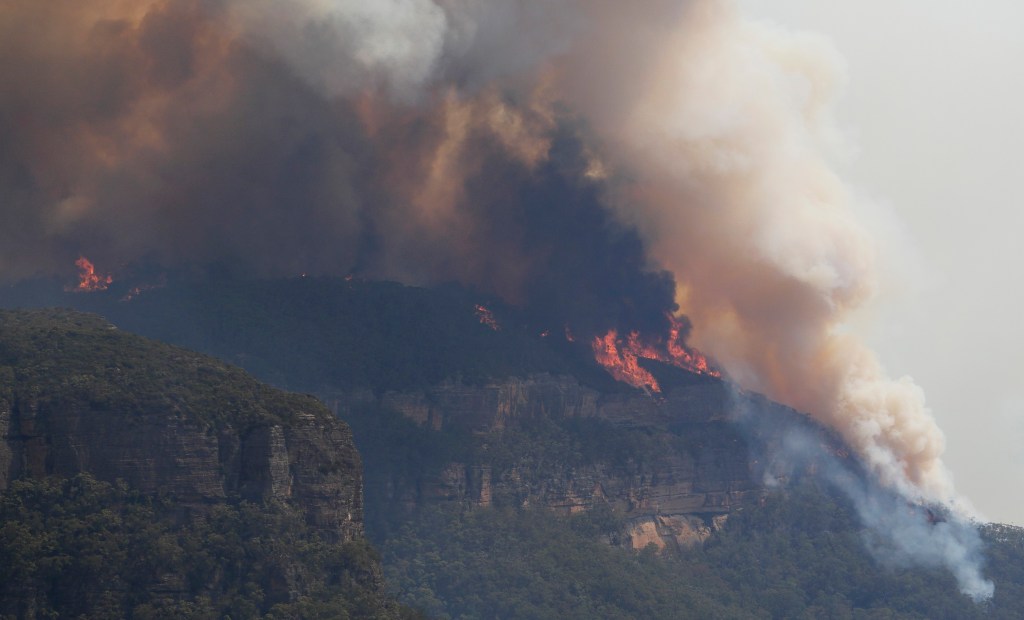
Which planned burns helped with controlling the 2019-2020 bushfires? How? Why? These vital questions have still not been analysed in detail. (Photo: IBG)
IBG suggested the following principles should apply to the planned burning (PB) program:
PB should be part of an integrated and coordinated multi-tenure program to manage bushfire risk and increase community resilience.
PB should be risk-based to maximise risk reduction within available resources and opportunities, i.e. optimised according to risk assessment and evidence.
PB should be focused mainly on the bushland interface (to reduce bushfire impacts on human assets) and specific strategic zones (to provide or reinforce a bushfire advantage). (NB. this excludes ‘ecological’ burning which may be done by land management agencies outside BFRMP adopted programs).
The PB program and the completed works should be transparent and rigorously measured and reported.
The efficacy of PB should be analysed and reported on an ongoing basis, both after wildfire events and in the absence thereof.
IBG also made a number of suggestions on how the planned burning program could be made more evidence-based and effective.
A version of the full IBG paper can be found on the IBG Our reports page.
The Australian Transport Safety Bureau (ATSB) is undertaking investigations into aerial firefighting safety across the country, prompted by the escalating risk environment: aerial firefighting activity has increased, and so has the number of safety occurrences.
The ATSB says aerial firefighting occurs in an inherently hazardous environment, and that since 2016 the ATSB has commenced 17 investigations involving aerial firefighting aircraft.
The recent study conducted in-depth interviews with 11 Australian firefighting agencies and 9 aerial firefighting operators. The report does not include findings, but presents the results of those interviews and the key safety themes that emerged. The report will feed into the larger safety study.
“The aim of the interviews was to better understand the aviation hazards interviewees faced, how aviation safety was managed, and the opportunities they could see to improve the safety of aerial firefighting operations.”
– Analysis of Australian aerial firefighting agency and operator interviews regarding aviation safety, ATSB Transport Safety Report, Safety Study – Part A, AS-2021-015a (Final – 13 May 2026)
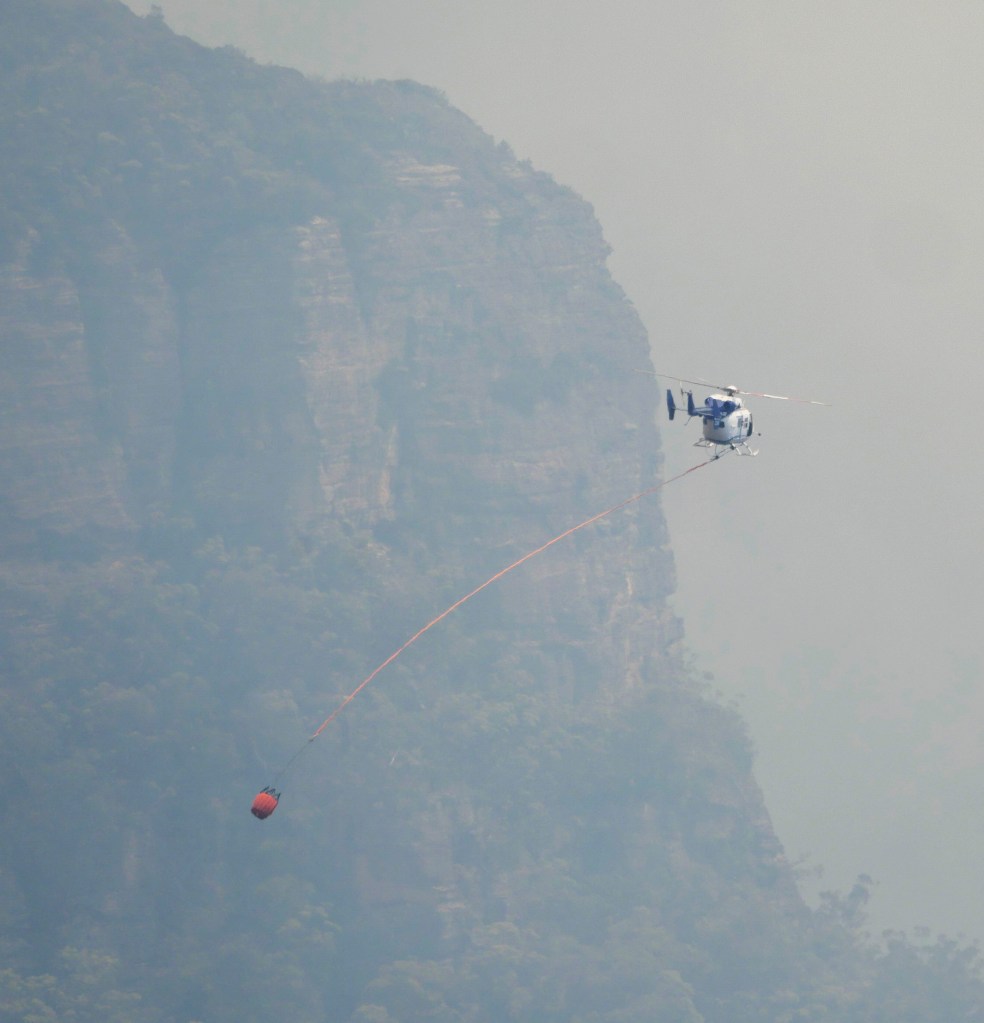
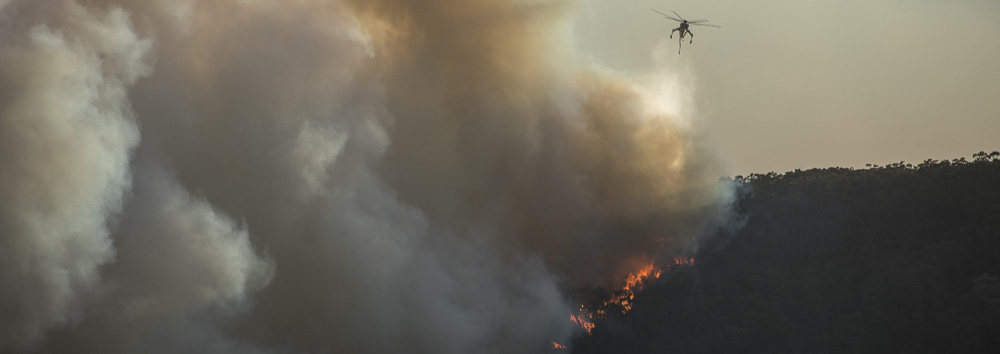
Aerial firefighting is inherently hazardous, with dangers including poor visibility and complex terrain. (Photo: IBG)
Key safety issues
18 key safety issues emerged from the interviews:
Safety culture – overview and leadership
Learning culture
Reporting culture
Informed culture
Just culture
Flexible culture
Standardisation
Informal risk management
Pressure to fly
Transfer of risk responsibility
Communication over the fireground
Aircraft coordination
Training and aviation proficiency of agency personnel
Pilot performance
Tasking and risk identification
Monitoring of changing risk conditions
High risk tolerance and risk normalisation
Commercial pressures
Report highlights
Here are a few of the more cogent statements from the report (direct quotes, emphasis added):
Most agency representatives spoke of a positive fire agency safety culture, while most operators spoke of a negative fire agency safety culture.
The New South Wales Rural Fire Service (NSW RFS) was identified as having a negative safety culture by 5 operators.
Interviewees perceived a lack of understanding of aviation safety and risk management among senior fire agency personnel across states and territories.
Overall, a degree of learning was occurring in some fire agencies, but it was still limited in its scope and application. Some fire agencies did not have a learning culture…
While fire agencies conducted post-incident reviews, and some reported a degree of trend analysis, these learning actions were limited in scope and had a short-term focus.
There was a perceived lack of a reporting culture within some fire agencies.
Some interviewees reported a fear of retribution for reporting incidents or safety concerns and a blame culture.
Some pilots and operators fear financial repercussions for speaking up.
There is a perceived lack of formalisation and documentation of risk management practices.
The biggest perceived sources of pressure [to fly] were from agency to aircrew and public or political pressure.
Interviewees identified public and political pressure for aircraft to be flown, particularly LATs, even when they were considered to be ineffective.
Over half of all interviewees expressed concern about the risk of collision.
Communication issues reportedly led to breakdowns in communication and an associated risk of collision.
Most interviewees considered some fire agency personnel to be lacking in aviation expertise, and some interviewees were concerned about the use of volunteers for aviation-related roles.
Interviewees highlighted tasking issues such as a lack of clarity of objectives, a lack of aviation experience of fire agency personnel leading to unrealistic tasking and unsuitable tasking for conditions and aircraft type.
“Agency representatives and operators sometimes had opposing views on the extent to which a safety aspect was being achieved, for example regarding safety culture and a pressure to fly.“
– Analysis of Australian aerial firefighting agency and operator interviews regarding aviation safety, ATSB Transport Safety Report, Safety Study – Part A, AS-2021-015a (Final – 13 May 2026)
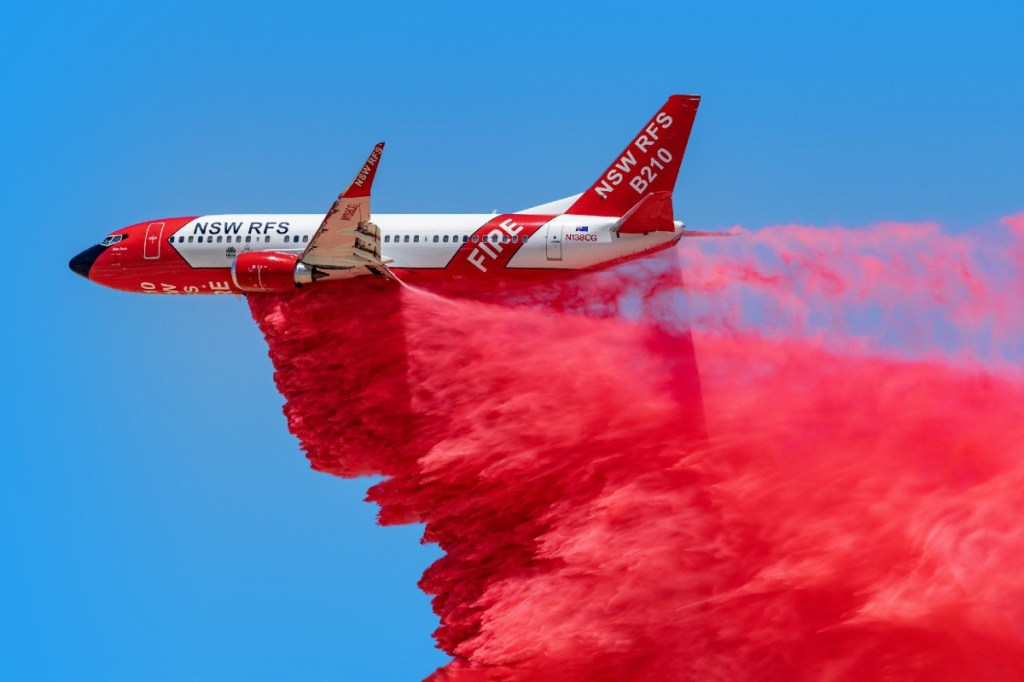
LATs are spectacular, powerful and expensive, and can be over-used for inappropriate tasks. (Photo: Coulson Aviation)
IBG comment
The overall impression from this report is disturbing, but also unsurprising. IBG has previously identified and commented on a number of the same safety and operational concerns. IBG is aware of some incidents, and that NSW operators and agency staff have safety concerns.
The report highlights the different perceptions of agency and operator interviewees, with agency staff generally reporting a more positive view of safety management compared to operators. This points to aviation safety as a blindspot for agency staff.
The report points out that 5 out of 9 operator interviewees identified NSW RFS as having a “negative safety culture”. A number of the other negative views reported might therefore also apply to this agency.
IBG has been long concerned with optimum use (tasking) of aircraft, especially LATs which can be tasked inappropriately due to unrealistic expectations (agency and public) and over-confidence in their effectiveness. This report confirms that many others in the industry share these concerns.
IBG’s previous post (below), other posts before it and IBG reports have drawn attention to the poor evidence base for aerial firefighting operations, as well as poor learning cultures. Meanwhile investment in aerial firefighting has continued at pace, informed by little in the public domain.
Sadly this report adds to a picture of dysfunction within the aerial firefighting industry. It will take a lot of work before this situation can be significantly improved, but this work is essential given the importance of aerial firefighting, the proven safety risks and the high financial costs.
IBG commends the ATSB for embarking unflinchingly on this safety review, and hopes the final report will identify how the situation can be quickly improved. IBG also notes that it will be great day when all aspects of firefighting receive the same level of rigorous review and analysis.
Natural Hazards Research Australia has released the first product of its Why Fly? research project: a review of the literature on aerial suppression effectiveness.
It is now more than two years since Why Fly? took off under the NHRA banner (see IBG post of November 28, 2024 below), and six years since the 2020 Royal Commission into National Natural Disaster Arrangements recommended research and evaluation into aerial firefighting be undertaken to assess the aerial suppression capability needs of states and territories and to explore effective aerial firefighting strategies.
It is more than three years since a Bushfire and Natural Hazards Cooperative Research Centre (forerunner of NHRA) paper on aviation tracking data recommended that “Fire management agencies should create an evaluation database that summarises objectives, outcomes, the number and type of aircraft, drops, type and litres, and ancillary observations such as weather, resources available etc.”
Aviation is an important but increasingly expensive fire fighting tool. IBG expressed concerns in our submissions to the NSW Bush Fire Inquiry and the Royal Commission that aircraft use could be improved.
“The use and effectiveness of firefighting aircraft in Australia is largely unknown, despite the significant amount of public money spent on them.”
(Review of aerial suppression effectiveness research literature, Plucinski, M., NHRA 2025, concluding discussion)
The NHRA literature review noted the paucity of research on the effectiveness of aerial suppression, and the many challenges in producing worthwhile findings. It summarises several broad and detailed studies from the US, but similar research in Australia has been hampered by poor data.
Better data for Australia is starting to be collected and the Why Fly? project is developing its methodology.
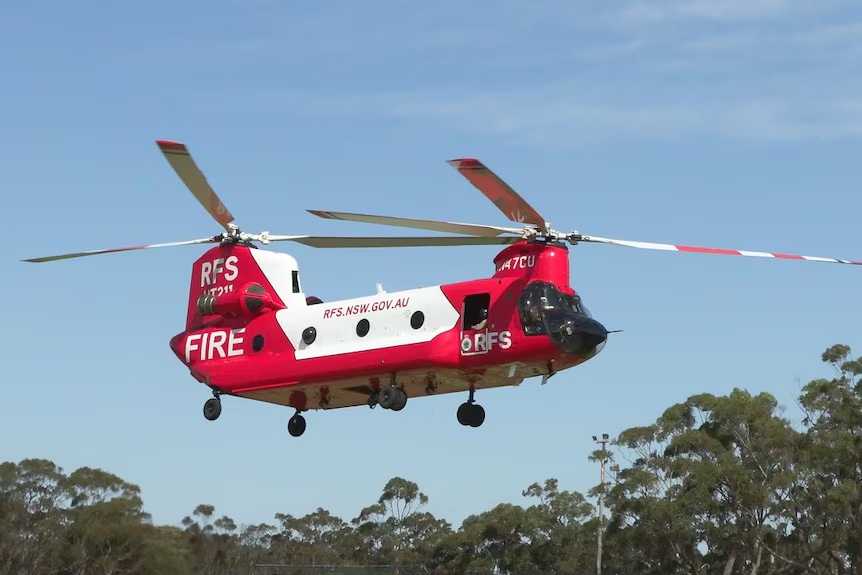
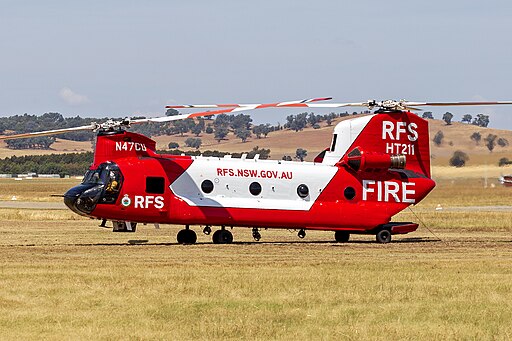
The NSW Rural Fire Service’s Chinook helicopter is being used for night water-bombing (Source: NSW RFS)
IBG comment
IBG is concerned that six years after the Royal Commission we still don’t have guidelines for effective use of different aircraft types.
It is also unclear if the comprehensive collection of data as recommended in 2023 is happening yet. This is essential if sound analysis and practical guidelines are to be produced.
IBG commends NHRA for their work so far and identifying what is needed to get on with data-driven quantitative analysis.
In the meantime, much can be achieved now with more qualitative research. IBG urges NSW fire agencies to conduct empirical research from fire aviation practitioners to learn from experience and generate use guidelines before the 2026/27 fire season.
“There have been no previous studies of aircraft use on Australian bushfires, other than a scoping study that presented some isolated examples demonstrating that aircraft tracking and event data are of great benefit for such research.”
(Review of aerial suppression effectiveness research literature, Plucinski, M., NHRA, 2025, executive summary)
On 26 June the NSW Government announced Trent Curtin as the new Commissioner of the Rural Fire Service, following the retirement of Rob Rogers from this vital emergency leadership role, after 40 years of service to the RFS.
“Mr Curtin commenced his career 30 years ago as a volunteer firefighter with the Country Fire Authority in Victoria and has served in senior leadership roles in the emergency services in both Victoria and NSW. These roles included Acting Deputy Commissioner and Assistant Commissioner at Fire and Rescue NSW with responsibility for Community Fire Unit volunteers. He also served as Assistant Chief Fire Officer at Fire Rescue Victoria between 2015 and 2020. Mr Curtin has extensive experience battling major fires, floods and coordinating large-scale responses involving multiple agencies to significant emergency incidents.”
Mr Curtin comes with a science degree and a Masters of Business Administration, and will commence duty on 14 July.
IBG comment
IBG wishes Mr Rogers well in retirement and congratulates Mr Curtin on his appointment. We look forward to how fresh leadership might enhance bushfire management in NSW.
The appointment of an ‘outsider’ to lead the RFS is a break from tradition. Since the creation of the RFS in 1997 under inaugural Commissioner Phil Koperberg, the two subsequent commissioners have come from deputy roles in the organisation.
Since its inception, IBG has advocated for improvements to how bushfires are managed, to reduce impacts on firefighters, communities and the environment. In a long list, concerns include a stronger focus on initial attack (especially for remote fires), evidence-based strategies for large fires, commitment to a strong learning culture supported with post-fire analysis, recruiting and retaining volunteers and professional fire experts, transparency, better inter-agency cooperation, a supportive culture and building community resilience.
The RFS deserves excellent and progressive leadership. It is hoped that the next period can be one of renewal and reform while all the best aspects of the organisation and its vital functions are retained and strengthened.
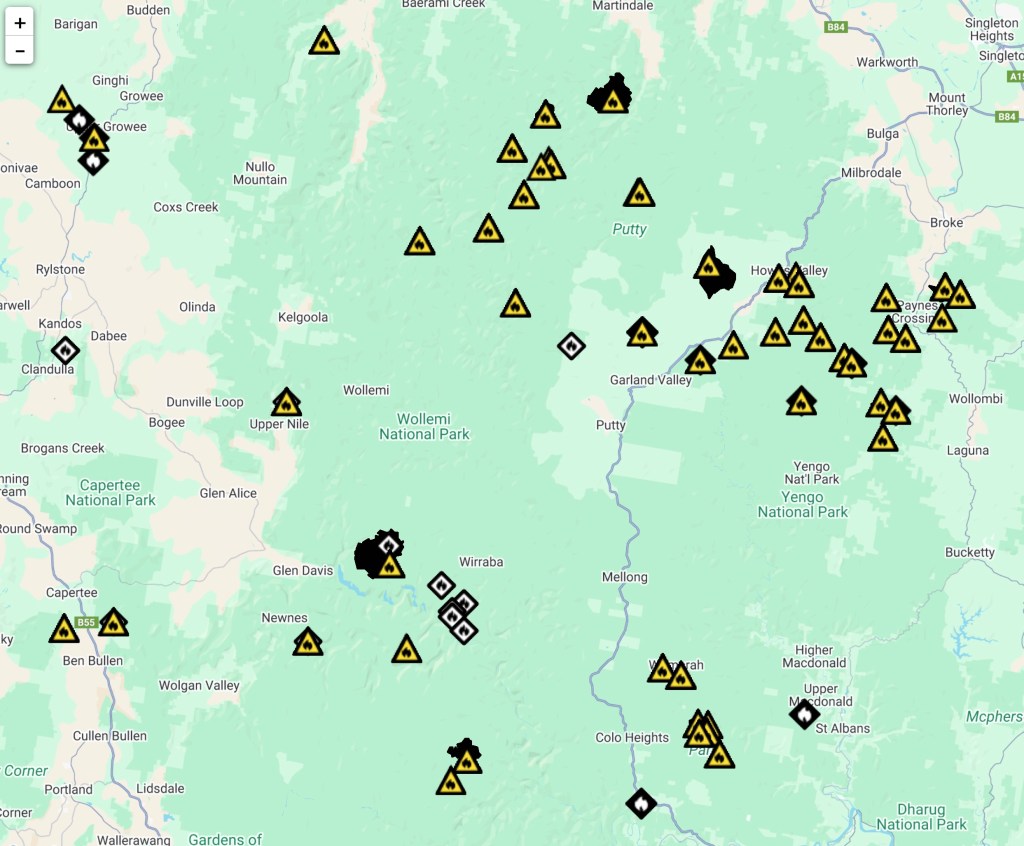
In late December 2024 to early January 2025, NSW firefighting authorities faced a run of numerous bushfires in remote locations. Most if not all were ignited by lightning. On 27 December storms swept over the Blue Mountains and about a dozen fires popped up across the northern parts of Wollemi and Yengo national parks and adjacent bushland.
Other fires occurred in remote parts of Blue Mountains, Kosciuszko and Oxley Wild Rivers national parks. With no access for ground vehicles, all these fires had to be managed with aerial attack and remote area firefighter teams (RAFT) taken to the fireground by helicopter. Fortuitously, although the weather was sometimes hot, overall firefighting conditions were moderate.
The Yengo-Wollemi Complex of fires on the morning of 29 December 2024 (Source: FiresNearMe)
More storms on 5 January brought more ignitions. At one stage there were more than 30 fires burning in the northern Blue Mountains, in the ‘Yengo-Wollemi Complex’ and further south. So many fires fires in the region has not been exceeded since 1997. While details are hard to come by (see below), it seems that while many of these fires were initially under NPWS management, all the Yengo-Wollemi fires were eventually placed in RFS control under three section 44 declarations, in Singleton-Muswellbrook, Lithgow and Hawkesbury LGAs. This generated large multi-agency campaigns.
The situation on the evening of 6 January 2025, after storms on 5 January ignited many more fires (Source: FiresNearMe)
At one stage, RFS Facebook posts said that 500 firefighters, IMT members and support teams were engaged in the effort, and on 6 January that 1.2 million litres of water per day was being transported onto the Singleton-Muswellbrook fires. Firefighters came from RFS, NPWS, Fire and Rescue and Forestry Corporation. This was perhaps the largest and most complex bushfire operation in NSW since Black Summer 2019-20. It received little to no mainstream media coverage, probably because no property was under imminent threat and high profile fires were running in Victoria at the time.
Most if not all of the fires were in areas burnt in Black Summer, raising concerns in some nearby communities that had been impacted. Some of the fires were quickly contained, while others spread and became ongoing challenges. Triage came into play, and resources were prioritised to fires according to the risks each one posed. Aerial attack (bombing with water, foam or retardant) can ‘knock down’ a fire, but only people on the ground or substantial rain can finish the job. The holiday period would have made mustering the large numbers of RAFT needed from NPWS and RFS more difficult.
Good news from the largest fire, at Dingo Creek in Wollemi National Park (Source: FiresNearMe)
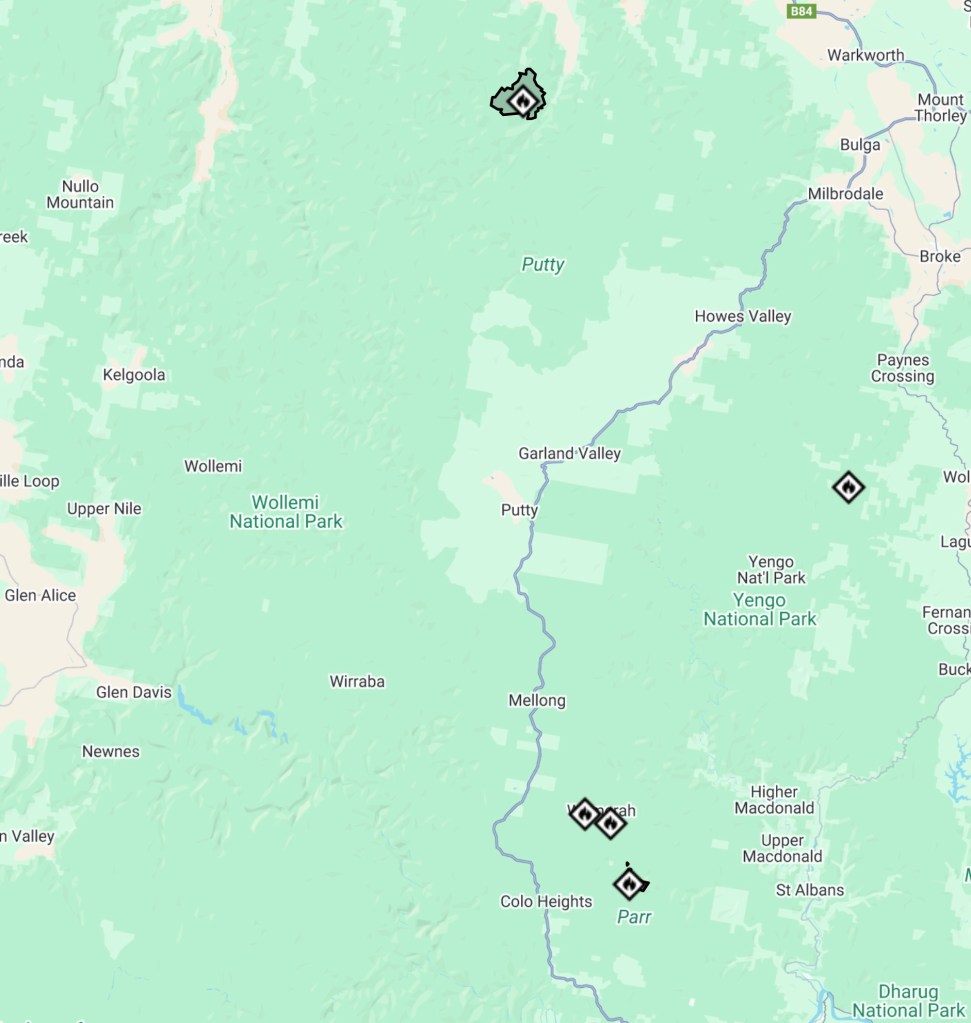
The largest fires grew to 1908 hectares (Dingo Creek, Wollemi NP) and 1796 hectares (Yarrowitch Trail, Oxley Wild Rivers NP) before being contained. In an impressive effort, nearly all fires were contained before rain stopped most play on 7 January. Continued rain saw all fires extinguished.
The situation on 16 January 2025: all fires contained after extensive rainfall (Source: FiresNearMe)
IBG comment
As probably the largest NSW fire operation since Black Summer, the Yengo-Wollemi Complex is a great opportunity to review how bushfire operations have improved or changed, especially for remote fires. The diversity of fires and possibly also differences in how they were managed would allow useful comparison of the most effective responses, strategies and tactics.
Given the paucity of past fire analysis by either RFS or NPWS, IBG is not confident that it will happen in this case. After Action Reviews, debriefs and lessons processes may now be in place across all agencies, but a proper understanding of time-and-event and the effectiveness of operations must be based on more than what people say. Hard evidence is essential, in the form of detailed record-keeping followed by objective analysis.
This run of fires in moderate conditions would have given numerous firefighters, leaders and support people a lot of valuable experience that should be built on with good analysis and review.
Since Black summer, IBG has strongly advocated for faster and stronger initial attack, especially on remote fires that can get out of hand quickly and create huge suppression problems. Bushfire authorities have expressed and adopted this mantra, and there has been an expansion of aerial resources and also RAFT numbers in RFS and NPWS. Multiple ignitions are a challenge to whatever preparations are in place, and it is as yet unclear how well the theory has translated into practice across these fires. Even if adequate resources are available, they need to be backed up with the right protocols and speed and weight of response.
Post from Tumut s44 on 30 December 2024 (source: RFS Facebook)
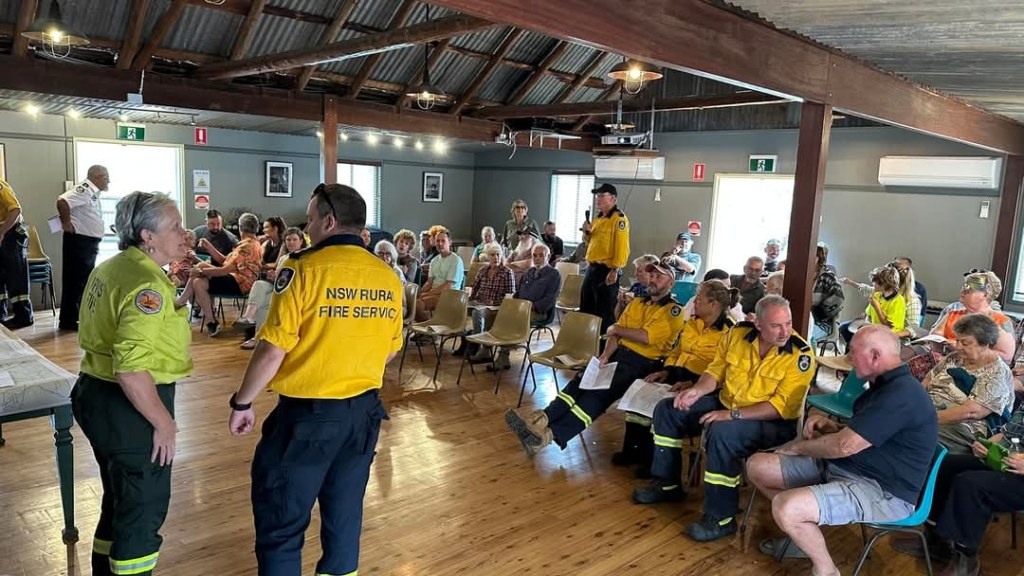
Multi-agency community engagement at Glen Alice in the Capertee Valley, near the Dingo Creek Fire (Source: RFS Facebook)
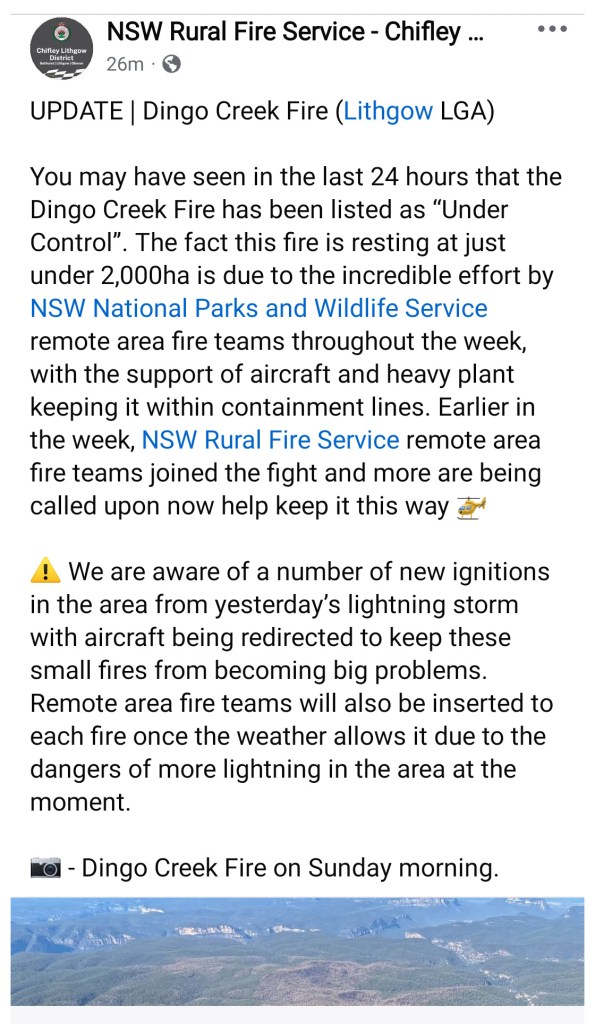
Official media coming out of RFS head office emphasised the role of RFS resources, especially aircraft and volunteers, however much of the RAFT work was done by NPWS staff firefighters. This corporate emphasis is understandable, but in section 44 fires RFS is in complete control of multi-agency operations and also public information which requires a more objective approach. However local RFS section 44 commands, such as in Lithgow (Chifley) and Tumut (Riverina Highlands), often highlighted the role of NPWS, Fire and Rescue, Forestry and other players in their own media. Giving due recognition to all participant is important in maintaining the morale and effectiveness of the entire bushfire industry.
Post from Lithgow s44 on 30 December 2024 (source: RFS Facebook)
understand and build the existing use profile of the aerial firefighting (water-bombing) platforms, across different states, territories and landscapes in Australia.
understand the profile of the purposes for which aerial firefighting platforms are deployed, and how effective that purpose has been.
The Australia-wide project will use more than 10 years of data from the ARENA database as well as case studies of specific aerial fire-fighting operations. The NSW RFS is assisting the research.
Loading the water bucket, Blue Mountains 2013
IBG comment
Aerial firefighting is an increasingly important part of bushfire suppression. It is also one of the main costs for large fires, so effectiveness and efficiency are vital issues.
The questions this research is asking are very good ones, and it is hoped the project will produce better guidance for bushfire operations. Given how difficult it is for independent citizen groups to obtain information about aircraft use, it also hoped that this project will provide some answers.
It is surprising that these questions are only now being asked, especially the first question about how aircraft are being used. IBG has long questioned whether the makeup of the NSW aerial firefighting fleet is optimal and being used to best effect during fires. Many active firefighters have similar concerns, with a lot of cynicism about how large air tankers (LATs) are deployed.
Specific issues of concern are the best mix of aircraft, particularly LATs versus smaller fixed-wing bombers, and the best options for initial attack on multiple fires. It seems the firefighting agencies do not have evidence-based answers to these issues, so this overdue research is very welcome.
Recommendation 50(b) from the 2020 NSW Bushfire Inquiry report called for Government to “work with states and territories through the National Aerial Firefighting Centre to review the current mix of aviation assets and determine whether it is fit-for-purpose, noting the current lack of mid-sized fire fighting aircraft“.
Recommendation 50(b) has been listed as “Complete” since June 2021, citing the development of the National Aerial Firefighting Strategy 2021-26. But the strategy does not include any ‘review’ of either the NSW fleet or the national fleet. In fact, the strategy repeatedly stresses that each jurisdiction needs to do its own review.
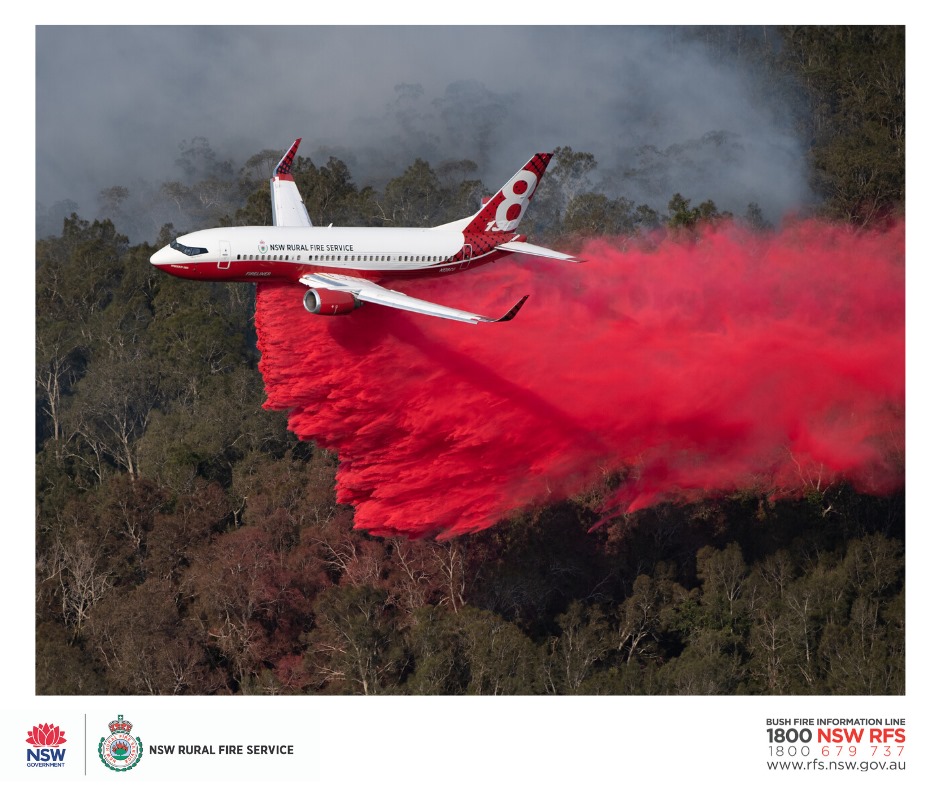
NSW RFS Large Air Tanker ‘Marie Bashir’ dropping fire retardant (Source: RFS Facebook)
The outcomes of Why Fly? will depend on the extent and quality of the available data. Data on aerial missions should include clear and measurable objectives with an assessment of effectiveness and the factors involved. For NSW at least, good aerial data such as this may be lacking.
As reported in a previous IBG post (April 5, 2023), a NSW pilot study into the Black Summer fires from NHRA (Investigating the suitability of aviation tracking data for use in bushfire suppression effectiveness research, January 2023) found that a lot of basic data was missing which “hamper learning and needs to be improved”. It is unclear whether data collection has improved since 2020, or whether the ‘evaluation database’ recommended by the study has been established.
“Fire management agencies should create an evaluation database that summarises objectives, outcomes, the number and type of aircraft, drops, type and litres, and ancillary observations such as weather, resources available etc.”
This inquiry by the Public Accounts Committee of the Legislative Assembly kicked off in February 2024 with public submissions followed by two hearing days in August and September. Full details, terms of reference, submissions and hearing transcripts are available on the inquiry’s web page.
The inquiry wanted to hear from “…people with first-hand experience, emergency service organisations and their volunteer associations and unions, local councils, bushfire experts, community groups and the public” (Media release, Public Accounts Committee, 20 February 2014).
The inquiry received 78 submissions and heard witnesses from about 26 organisations, mainly local councils but also government agencies, RFS brigades and the IBG. The three main firefighter representative groups made submissions: Rural Fire Service Association (official representative body for RFS volunteers), Volunteer Fire Fighters Association (alternative and independent body for RFS volunteers) and Fire Brigade Employees Union (union representing NSW Fire and Rescue employees).
The inquiry seems to have been prompted mainly by the complicated management arrangements for the ‘red fleet’ (RFS firefighting vehicles) and local bushfire premises (eg. local brigade fire sheds), as highlighted by the local government sector and NSW Audit Office (see their 2023 report: “Planning and managing bushfire equipment” and IBG post of March 20, 2023). The inquiry is also interested in the roles of RFS and local government in bushire management and district bushfire management committees.
Many of these issues go back to legislation which created the Rural Fire Service in 1997, and also reduced the previous major role of local government in bushfire brigades and bushfire management. Many submissions to the inquiry regard the existing arrangements for assets and premises as no longer fit for purpose and in need of reform. Local government in particular is concerned about the administrative and cost burden on their sector, when they have little or no control of assets on their books.
A repeated concern in submissions was the need to reform the Rural Fires Act 1997, which includes artefacts from previous legislation and provisions about assets that are no longer practical. Some submissions called for the oft-cited number of 70,000+ RFS members to be audited, and queried the efficacy of funding the RFS via the NSW emergency services levy on ratepayers.
Given the almost universal concern that ‘red fleet’ management is unnecessarily complex and inconsistent, it seems likely that the inquiry will recommend rationalisation of the ownership and management of these vehicles.
The inquiry will also report on other issues from the terms of reference.
IBG comment
While some of these ‘administrative’ issues may seem peripheral, they do impact the effectiveness of the state’s bushfire management capability. Efficiency is important.
The many issues around assets, premises and funding need to be considered within the bigger picture: that is, what is required to achieve clear objectives – putting fires out and protecting people, property and the environment. There is a vital need for more operational analysis, a strong learning culture and financial accountability, coupled with independent oversight.
NSW lacks an over-arching bushfire strategy. There is no statewide risk analysis to inform prevention and suppression.
In its submission, IBG urged a full review of RFS functions and the roles of RFS and local government, pointing out that beyond equipment management, local government could be more involved in other aspects of bushfire and especially in building disaster resilience in communities.
IBG noted the disparity in the standard of bushfire sheds and suggested a statewide audit followed by an upgrade program.
IBG documented the lack of a strategic approach to aerial assets (aircraft) and the need for better data and analysis.
IBG called for an audit of RFS volunteer numbers and stressed the need for a recruitment strategy and greater diversity.
IBG recommended that NSW needs a stronger learning culture in emergency operations, with an Inspector General of Emergency Management to lead this and provide assurance and accountability to the emergency sector.
On financial accountability, IBG pointed out the paucity of research on bushfire suppression to assist the best decision-making, and urged more analysis of large bushfire operations coupled with evaluation of the effectiveness of past expenditure.
Submissions can’t be published on this website due to parliamentary inquiry rules. All submissions can be seen on the inquiry’s web page.
The recently established NSW Bushfire & Natural Hazards Research Centre (see post below of 24 July) has published their research program. Most of the 19 projects are bushfire-related, covering topics as diverse as smoke hazards, fuel management, early detection of lightning fires, backburning, ecological management, fire retardant impacts and utilising FESM (fire extent severity mapping). Many of the projects are classified as “large > $200,000” with timeframes running up to 2+ years.
The BNHRC is an extraordinarypartnership between eight NSW Government end-user agencies…and six participating universities (WSU, UNSW, UOW, ANU, UMelb, and UTAS).
– BNHRC website
This program is a major step up in research to support and improve evidence-based fire management, and one of the more progressive outcomes from the NSW Independent Bushfire Inquiry. Interested people can sign up online for the centre’s newsletter.
IBG comment
This extensive research program is very welcome, especially in the previously depauperate landscape of research to help bushfire operations. For some projects, the 2019-2020 season will provide a wealth of data and examples. All research outputs should be published.
It is hoped the outputs will also be useful and robust enough to encourage the government to extend the life of the BNHRC beyond the few years currently funded. The potential economic payoff in bushfire management costs and impacts from this investment is considerable, noting that a $200,000 project is equivalent to the cost of about three drops from the NSW Marie Bashir VLAT (very large air tanker).
A number of projects are particularly relevant to issues on which IBG has been advocating. These include backburning and the ecological impacts of fire. These projects arise from specific recommendations of the NSW Bushfire Inquiry which handed down its report in 2020. After a long wait of four years its encouraging to see those recommendations activated.
The backburning and fire-break project will need to delve deeply into the operational details of examples to determine the fundamental reasons for successful and unsuccessful burns, in order to produce guidance for future operations. These details include not only fire and weather conditions, but also the resources used and how and when actions were undertaken.
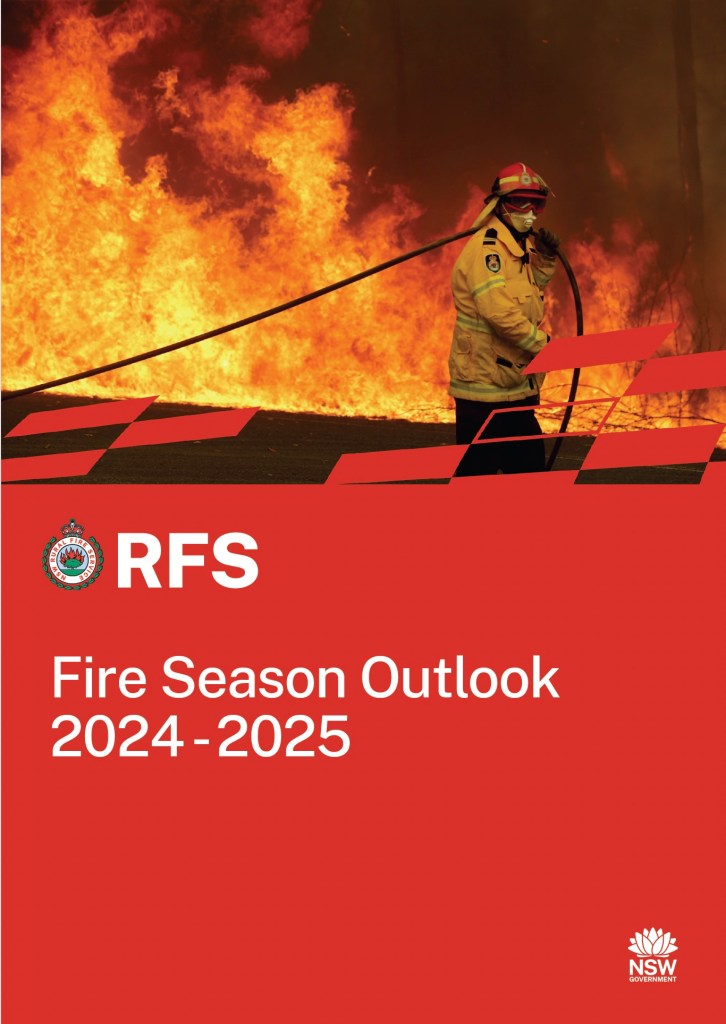
As an outcome of the NSW Independent Bushfire Inquiry, each year the NSW Rural Fire Service (RFS) releases a Fire Season Outlook for the coming bushfire season. The Outlook for 2024-25 was recently tabled in NSW Parliament. It contains a lot of helpful information and deserves wide exposure, especially within at-risk communities.
The inquiry’s 2nd recommendation said that the public statement from the Government: “…should form the basis for clear public communication about these risks on a regional basis and the actions that Government proposes in preparation.”
This year’s report includes a forecast of weather and fuel conditions for the upcoming season and a summary of preparation that has been undertaken, including hazard reduction works. The Predicted Fire Season Outlook (page 5) maps all of NSW at ‘normal’ fire potential, while pointing out that forest areas burnt in 2019-2020 may carry fire again. This is partly because of the regrowth that has occurred during the past few wet years.
The report also identifies that grassland areas of NSW could dry out enough to pose an above normal risk.
The resource capabilities of the four firefighting agencies are listed on page 13, showing a total of 1,510 remote area firefighters across RFS and National Parks and Wildlife Service, 510 Community Fire Units supported by Fire and Rescue NSW, and over 5,500 firefighting appliances (tankers, pumpers, etc) across all four agencies.
In broad terms, the key risks for the 2024-25 bush fire season include:
– Grassland areas west of the Great Dividing Range may pose an above normal risk, particularly later in the fire season.
– Once dry, forest areas could carry fast and intense fires under elevated fire danger conditions. This includes areas that were burnt during the 2019-20 Black Summer fires, many of which have now recovered.
Fire Season Outlook 2024-2025 (NSW Rural Fire Service, n.d.)
On Saturday 21 September a planned burn for hazard reduction near Oxford Falls on Sydney’s northern beaches escaped containment and spread rapidly south-east to a much larger area.
At times the fire behaviour and flame heights were severe. This was two days after the first total fire ban for the season in the Sydney area. During the afternoon the threat to life and property was deemed imminent and an emergency ‘too late to leave’ alert was issued to local residents. The response to the emergency involved hundreds of firefighters and a number of aircraft.
The ‘Meatworks’ hazard reduction was reportedly planned to be 24 hectares in size. The larger fire was succesfully contained on 23 September at 147 hectares (Source: Fires Near Me).
Early stages of the breakout of the Oxford Falls planned fire, 21 September 2024 (Source: Fires Near Me)
The breakout fire was prominent from many parts of Sydney, and provoked much commentary. Not all of it was well-informed, but many volunteer firefighters expressed dismay and anger on the Rural Fire Service facebook page.
On 24 September, the Commissioner of the Rural Fire Service issued a memo to the RFS saying “We will be conducting a local After Action Review along with a formal internal inquiry to assess if any improvements can be made to avoid such occurrences in the future“.
Continuous improvement is key to ensuring our firefighting efforts remain effective and safe for both our members and the community.
– RFS Commissioner Rob Rogers, RFS memo 24 September 2024
Later stage of the Oxford Falls breakout, 21 September 2024 (Source: Fires Near Me)
Media coverage
Mainstream media reported on the crisis as it unfolded and, to a lesser extent, on the context and aftermath:
ABC News, 21 September 2024: ‘Bushfire burning in Sydney’s Northern Beaches downgraded from Emergency warning to Advice’
An IBGopinion article related to this event was published in the Sydney Morning Herald online on 25 September and in the print edition on 27 September:
The Sydney Morning Herald article includes some IBG comment, but there is more to say. IBG has written about many of those issues before, much of it on this website. Planned burns are a complex management task, with many risk factors and opportunities to go wrong. All risk factors need to be considered for each burn, but not all risks can be controlled.
Planned burns (both prescribed burns for hazard reduction and backburns for controlling wildfires) have escaped in the past and more will escape in the future. IBG members have themselves lost burns in their firefighting careers. In 2020 a burn by Fire and Rescue NSW and the National Parks and Wildlife Service escaped prominently at North Head in Sydney. The important response is not to assign blame but to analyse why these events happen and identify and act upon the lessons learned.
Past experience and analysis has shown that firefighting agencies have insufficient commitment and capacity to properly examine and learn from negative outcomes. And the same applies to good outcomes, where it is just as important to learn how these were achieved. Identifying lessons is not enough; lessons must be documented, promulgated to firefighters and built into practice. There is a vast literature with guidelines and policies on lessons management, but they are insufficiently applied.
Whilst an After Action Review (involving those involved) of the Meatworks incident is a welcome commitment, it should have been routine and has to be well managed, while the internal review is also welcome but inadequate. Any agency investigating itself has a conflicted and impossible task. This is not the best way to produce a report that will be seen by the community as thorough and objective.
Some may say that backburning (which requires much the same planning and skills as prescribed burning) has been well examined, and point to the 2020 NSW Bushfire Inquiry and the 2024 NSW Bushfires Coronials. But this is incorrect. The inquiry did not look at any backburns in detail. The coronials examined only a few, and left many questions about those few unanswered. Most backburns from the 2019-2020 bushfires remain unexamined, whether successful or unsuccessful.
Expert research on backburn and prescribed burn escapes has to date been minimal, and it is essential that more happens to provide better guidance to firefighters. A new project being run by the new NSW Bushfire and Natural Hazards Research Centre (see IBG post of July 24 below) should help to fill this gap, but it comes nearly five years after the 2019-2020 fires which provide such a strong evidence base. The project “Evaluating backburning and fire-break operations” will take two years and more than $200,000. Such evaluation needs to be ongoing.
Reviews, inquiries and research should be routine, expert and independent. These are some of the reasons the IBG has been pushing for an Inspector General of Emergency Management for NSW. This is the only way to ensure the right lessons are learned and acted upon for continuous improvement, while also reducing controversy and the ongoing cycle of one-off and inadequate reviews.
Review bodies for many other public safety industries have shown the way. Police, health, the military, even the intelligence services, have independent oversight bodies. They should be welcomed by agencies and government as a positive boon to continuous improvement, safety for all and transparency.
Burning for hazard reduction is another very complex issue (see IBG post of 21 July below: “Shortfall in planned burning”). Public and media understanding of the costs, benefits, challenges and technicalities is often poor. Fuel reduction can be useful, especially close to assets and to strengthen natural fire barriers. But, as several RFS Commissioners have said, burning is no panacea. Burning is a useful tool when used well, and partly a numbers game. That is, each effective burn will offer some assistance and protection to a limited area for a limited time, but only if a wildfire threatens within that period.
IBG does not support area-based ‘targets’ because the focus on strategic burning for specific benefits can be replaced with a focus on hectares burnt. ‘Properties protected’ targets are better, but still somewhat fraught. As pressure to burn increases, and as burns perhaps are pushed into more marginal opportunities, the community needs to understand that escapes may become more likely, with increased risk of impacts.
Educative and constructive public discussion is essential to optimise the use of limited burning resources (and weather windows to do burns) and also to maintain some kind of consensus within the community. IBG will continue to contribute to this discussion.










.jpg)