The final Stage 2 public hearings of the NSW Bushfires Coronial Inquiry took place from 15 to 26 May 2023. The topic, one of several systemic issues identified from the Stage 1 hearings, was Backburning Operations – planning and execution.
The hearings mainly considered two backburns that were of high consequence and public interest – near Mount Wilson in the Blue Mountains on 14 December 2019 (related to the Gospers Mountain Fire) and near Yatte Yattah on the South Coast on 30 December 2019 (related to the Currowan fire).
The Coronial Inquiry previously heard that the Mount Wilson backburn escaped containment to spread over a large area and cause considerable damage, including to 100 homes. The level to which the backburn at Yatte Yattah contributed to the tragic bushfire impacts around Conjola Park and surrounds is less clear.
The Coroner heard summaries of these events and questions to be investigated from Counsel Assisting, then witnesses from the Rural Fire Service (mainly), one witness from the NSW National Parks and Wildlife Service (re. Mt Wilson) and a commissioned Expert Witness (re. both events).
The hearings involved questioning on specific events, to determine what actually happened, as well as on the planning and execution of these backburns. At times there was conflicting evidence and a lack of records to assist resolution. The Expert Witness provided his assessment of events and decisions, “based on the brief of evidence”, and his recommendations.
All hearings can be viewed on theCoroner’s youtube channel. Mount Wilson was heard on coronial Days 66 to 70, and Currowan on Days 71-. Media coverage was mainly by the ABC electronic and online, and generally limited to reporting what was heard in the hearings, as appropriate for an ongoing inquiry. Links to online stories appear below.
Closing submissions on Stage 1 and 2 hearings are scheduled for 7-11 August 2023, followed by the delivery of findings at an as yet unspecified date.
A lot of attention has been given to backburning, but it is one method of many used to manage wildfires, especially large and long-running fires. IBG would like to see a more holistic approach and review of strategies for large fires.
The Victorian Alps is an area of unique biodiversity that evolved under specific climatic conditions resulting in unique Alpine habitats that are under extreme threat from the potential impacts of climate change.
This Friends of the Earth report “An Icon at Risk – Current and Emerging Threats to the Victorian High Country” highlights these many threats to the fragile Alpine environment. It starts by quoting from Victoria’s Inspector-General for Emergency Management (IGEM) investigation into the 2019/20 fires, ’the past is no longer a reliable guide to the influence of climate and weather upon bushfires into the future’.
The 2019/20 fires burnt through 1.5 million hectares of this region in Victoria, NSW and the ACT. Additional threats to the region include ‘salvage’ logging of burnt areas, logging of precious unburnt forest, invasive plants and animals, feral horses and overdevelopment. Overarching all of this are the threats posed by climate change. Predicted changes in the climate will result in decreased snow fall, higher temperatures, increased fire frequency, longer fire seasons and decreased overall rainfall but increased intense rainfall events,
Alpine Ash forests did not evolve to tolerate hot fires. In the last 20 years, 85% of Alpine Ash forests have been burnt by hot fires, in some cases several times. This species requires a minimum of 20 years and up to 30 years between fire events for regrowth to be mature enough to produce viable seed. When this does not occur, changes in the structure and diversity of these forests will result. NSW also has significant areas of alpine ash regrowth that needs protection.
To protect these Alpine areas and their unique habitats, vegetation and wildlife, the report recommends the following actions to be implemented in regard to fire.
Increase remote area firefighting resources
A remote area volunteer firefighting force
Urban volunteer fire fighters
A national remote area fire fighting force
Additional air capacity
Broaden intervention to protect threatened vegetation communities
Re-thinking prescribed burning
IBG comment
The NSW High Country faces similar threats, with significant areas of Alpine Ash regrowth that need protection from further fire events. The Independent Bushfire Group supports these recommendations from the Friends of the Earth report and has been advocating for similar initiatives.
Left: Alpine Ash regrowth after fire Right: Unburnt Alpine Ash forest (both Kosciuszko National Park)
The NSW Coroner investigates deaths, and the cause and origin of fires. Bushfires that lead to property loss or deaths are usually the subject of a Coronial Inquiry, and the Coroner may also examine systemic issues that arise from such an inquiry.
Twenty-five people including six firefighters died in NSW in the Black Summer bushfires, with 2448 houses destroyed, 5.5 million hectares burnt with the loss of large numbers of native wildlife and stock and $1.88 billion in insurance costs. More detail on the impacts can be found here.
Coronial proceedings commenced on 25 August 2021 and hearings are scheduled to continue to the end of May 2023. Stage 1 hearings considered deaths and 44 of the Black Summer fires, with many hearings held in the regions.
The Stage 2 hearings are examining case studies which represent major issues emerging from Stage 1. Topics heard in 2022 have included Public Warnings, Bushfire Investigations by the Rural Fire Service and Police, and Bushfire Risk Classifications. The 2023 Stage 2 hearings are on Vehicle Design and Safety, Fire Prediction Modelling and Backburning Operations – Planning and Execution. As at April 7, the only remaining topic to be heard is Backburning, with hearings scheduled for 15-26 May 2023. All hearings can be viewed live online or later on the Coroner’s youtube channel.
The ‘fog of fire’
Systemic issues
Systemic concerns identified in the hearings include:
Public Warnings – timing, accuracy and effectiveness
Bushfire Investigations by Rural Fire Service and Police – distinguishing one fire from another, the naming of fires, which fires are investigated, who should do investigations and the quality of those investigations
Vehicle Design and Safety – protection from rollovers and falling objects
Fire Prediction Modelling – use and quality of predictions
Backburning Operations – planning and execution (not yet heard)
Some of these concerns are connected. For instance, fire predictions inform public warnings and backburning. The Coroner has engaged independent expert witnesses to assist with examining some of these topics, and to help identify practical improvements.
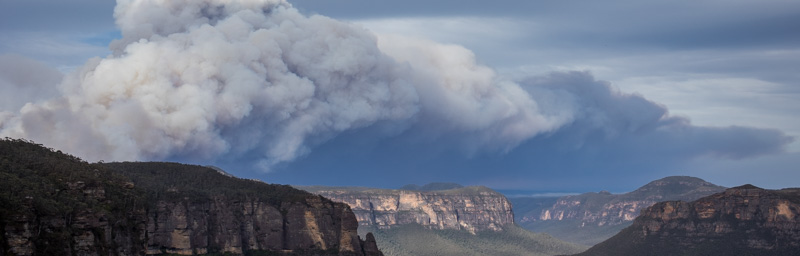
The origin of this escaped containment burn in the Blue Mountains was investigated where it later crossed the Grose River (the valley in the image)
IBG comment
Any comment while the Coronial Inquiry is in progress must be limited and cautious.
IBG has previously observed that the existing system of public and coronial inquiries, while producing useful outcomes and serving some other purposes, is not be the best way to examine bushfire operations and promote improvements. The IBG position is explained further in the IBG submission to the Select Committee on Coronial Jurisdiction in NSW.
IBG has also urged the NSW government to establish an Inspector-General of Emergency Management (IGEM) for NSW as exists in Victoria and Queensland. The role would be expert and independent of combat agencies. It would design continuous learning processes and oversee their implementation. The IGEM would greatly assist the work of the Coroner.
The way the current Coronial Inquiry is forensically examining some systemic issues is encouraging.
The hearings into Bushfire Investigations (19-20 September 2022) highlighted issues with how fires are defined, which fires are investigated and which agency does the investigation. In one case of an escaped backburn, the police investigation was diverted to a location unrelated to the fire origin.
Bushfire Warnings (21 and 23 September 2022) looked at examples where emergency warnings were not issued in time before communities were impacted by fire.
The hearing into Vehicle Design and Safety (29 March 2023) involved independent expert witnesses in a productive three-way discussion about better protection of vehicle occupants. Some of those experts were already working with the Rural Fire Service to examine options and act on vehicle improvements. This is a commendable example of how an issue can be acknowledged and progressed collaboratively and with commitment. It is to be hoped that other systemic issues can be progressed in a similar way.
The hearing into Fire Prediction Modelling (4 April 2023) explored the relative merits and accuracy of the several models in use, and some better alternatives being developed. The IBG was pleased to hear about the prospect of improved models and greater emphasis on atmospheric stability in fire behaviour prediction and backburning.
IBG has a particular interest in the appropriate use of backburning, which is a vital option for controlling wildfires, yet risky and problem-prone. IBG’s 2020 report Reducing the Costs and Impacts of Bushfires and Fire Case Studiesexamined backburning issues in detail. The Coroner has been made aware of these IBG reports and studies. In response to the hearing on Bushfire Investigations, IBG wrote to the Coroner suggesting improvements to the way these are undertaken. IBG recommendations included:
Significant (ie. strategic) backburns and those ignited some distance from the wildfire should be treated as new ignitions. Any ‘escaped’ backburn, of any scale or location, should also be treated as a new ignition, to trigger the investigation system.
Any subsequent investigation should be managed at arm’s length with independent oversight (as in Police Critical Incidents).
All bushfire investigations should be required to seek evidence and statements from all relevant participants.
Oversight by an Inspector General of Emergency Management.
The authors list the multiple inquiries that have called for research into the effectiveness of firefighting aircraft – a research blind spot. The BNHCRC report adopted terminology from a pioneer US project on Aerial Firefighting Use and Effectiveness, which was prompted by ongoing US government frustration over the cost of aerial firefighting and the lack of evaluation. To assess the effectiveness of aerial drops, the US project used five objectives (eg. initial attack, property protection) and seven outcomes (eg. the drop delayed fire spread, protected assets successfully). However the nine-year, $US11 million project produced limited results.
Location tracking is mandated for all Australian firefighting aircraft, but only some are required to have firebombing event logging (drops and fills etc.). NSW data was lacking in many parameters:
60% of specialised bombing aircraft had no drop data, including at least two LATs, one being the RFS 737;
63 of 64 smaller aircraft (including 48 firebirds) also had no drop data;
the actual drop product used (water, gel, foam, retardant) was missing in 70% of cases;
drop volume was missing in 44% of cases;
drop objectives were often not recorded.
Firebombing aircraft include large and medium helicopters, single engine air tankers (SEATs) and large air tankers (LATs).) To overcome some of the data shortfall, 10 experienced Air Attack Supervisors (AAS) from the NSW Rural Fire Service, NSW National Parks and Wildlife Service and British Columbia Wildfire Service were interviewed about specific Black Summer fire events they worked on in NSW. They were also asked: “What improvements could be made to data gathering or the reporting systems to improve our ability to learn” (page 35). They had many ideas and all supported a routine interview or survey of AAS after future bushfires.
The report includes eight case studies of “particular days at a particular part of a fire”, using both recorded data and information from interviewees. The case studies provide examples where aerial bombing was deemed effective, ineffective or inconclusive. The report emphasises that in the absence of information about on-ground activity and many other factors, assessing outcomes is problematic.
The paper also cites the cost of NSW aerial firefighting in Black Summer, which was $306.3 million. This included six LATs and VLATs (very large air tankers) dropping 24 million litres on 1708 missions (NSW Rural Fire Service, Royal Commission Into National Natural Disaster Arrangements, Notice & Summons to Give information NTG-HB2-209, pages 20-21).
The BNHCRC report found that: “…this data has the potential to facilitate comprehensive analyses of aerial firefighting effectiveness that were not previously possible. This work explored methods and case studies that could be expanded into comprehensive evaluation” (page 54). However the missing data “hamper learning and needs to be improved”.
The authors make a number of recommendations, including (page 55):
“There should be a routine interview or survey process for AAS after the bushfires…aimed at identifying objectives and outcomes”.
“Fire management agencies should create an evaluation database that summarises objectives, outcomes, the number and type of aircraft, drops, type and litres, and ancillary observations such as weather, resources available etc“.
“The next step would be to investigate the conditions associated with success or failure, including weather, size and behaviour of the fire, scale of the objective, amount of resources available, drop quantity and type etc. Ultimately, there should be research that examines the full context of aerial suppression, which includes how effective it is when combined with other types and amounts of suppression…”
(Investigating the suitability of aviation tracking data for use in bushfire suppression effectiveness research, page 55)
IBG comment
This report yet again highlights the dearth and critical need for more bushfire suppression analysis and research, especially on firefighting strategies and effectiveness. This is a core focus for IBG’s work.
The lack of adequate data on which to base analysis indicates a longstanding disinterest by fire agencies in learning from past operations, and a tragic lost opportunity from the important lessons that should have come out of Black Summer. There is little evidence that this situation is improving. IBG asserts NSW needs an independent Inspector General of Emergency Management to drive learning culture.
Aerial operations are an essential and important part of bushfire suppression. But the massive cost is not matched by the evidence base to understand what works best and what doesn’t, especially for bombing work. Aircraft continue to be purchased and contracted without evaluation of the best mix of aircraft and the best use for each type of aircraft.
The BNHCRC report recommendations and “next step” (quoted above) are strongly supported as essential to optimising the use of firefighting aircraft to reduce bushfire impacts.
“When a [US] federal agency spends more than half a billion dollars in a year on one activity such as fire aviation with very little meaningful oversight, it needs to have a robust knowledge base for making decisions about how to spend those taxpayer dollars.”
“In conditions like we have seen in recent decades, fire agencies, including those who mostly grow trees, should be extremely confident their aerial fleets are comprised of the most capable aircraft in adequate numbers so that all wildland fires that are being suppressed can be attacked from the air within the first 20 minutes, supporting firefighters on the ground. This is just basic Homeland Security.”
Bill Gabbert, writing inFire Aviation(US online magazine), April 16 2021, on “What did we learn from the Aerial Firefighting Use and Effectiveness study?“
Powder keg: Australia primed to burn (February 2023) points out that grass growth has been prolific, so major grass fires are likely as we move into a drier period (as climate models forecast).
The report calls for governments to “prepare for a dangerous fire season later in 2023“, through increased funding, more staff and volunteers, permanent disaster recovery arrangements, more funds for community resilience and stronger emission cuts.
An opinion piece from lead report author Greg Mullins highlights the danger of fast-moving grass fires, and some history of previous extensive grass fires.
IBG comment
Recent large fires in the NSW ‘grass belt’ point to an emerging threat later this year.
IBG asserts that not enough has changed in NSW fire management systems to prevent similar outcomes in the future as happened in Black Summer. Hence IBG supports ELCA’s call for more investment and preparation in critical areas. It is also vital that investment is based on evidence, well targeted and assessed for effectiveness.
In January 2023 the Bushfire and Natural Hazards Cooperative Research Centre (BNHCRC) released a tranche of reports on research emerging from the Black Summer fires of 2019-2020.
The CRC received $2 million from the Australian Government to explore immediate issues arising from the fires. The CRC and partner agencies also allocated funds for more specific research projects. The research was based on the main issues identified in various inquiries, and grouped into four broad themes: fire predictive services, cultural land management, community-centred disaster risk reduction and bushfire data and reconstruction.
The various reports as well as the summary can be found here.
IBG comment
IBG advocates for a rapid expansion of bushfire research, so this collection is a welcome addition.
The funds allocated to solving critical questions in bushfire management are very small compared to what is spent on bushfire mitigation, suppression and recovery.
With a focus on operational improvement, IBG is particularly interested in the projects on aerial firefighting, bushfire predictions, weather and fire reconstructions/analysis. However some of these studies deliver less than expected, with either a narrow focus or discovering that data was not adequate to support more useful findings. This highlights both the lack of historical support for data and research, and the preliminary nature of much bushfire research. Much more work needs to be done if the impacts of future severe fires are to be reduced.
In subsequent posts IBG will progressively review some of the more interesting reports from this BNHCRC collection.
A recent report from the NSW Auditor-General “assessed the effectiveness of the NSW Rural Fire Service (RFS) and local councils in planning and managing equipment for bushfire prevention, mitigation, and suppression.” The report focused mainly on the RFS fire fighting fleet, which comprises land vehicles, marine craft and aircraft, all of which are integral to the agency’s overall bushfire risk management.
The report, released on 27 February 2023, notes the confusion of roles between the RFS and local government for the maintenance of certain land-based fleet and that, despite this being raised in local government audits over several years, has not been resolved by legislative amendment. This puts at risk the readiness of the fleet when a fire starts.
The report also notes the substantial progress made by the RFS in modernising its firefighting fleet and making it safer for fire fighters. The report states that the average age of fire fleet has been reduced from 21 years in 2017 to 16 years in 2022 but remains short of the target average age of 15 years.
The report observes that the RFS could not demonstrate a strategic process for acquisition of aviation fleet and early detection technologies to deliver their target of smaller fires, which is to limit 80% of fires to under 10ha in size.
The Audit Office’s highlights summary describes the main concerns under What we found:
The RFS has focused its fleet development activity on modernising and improving the safety of its firefighting fleet, and on the purchase of new firefighting aircraft.
There is limited evidence that the RFS has undertaken strategic fleet planning or assessment of the capability of the firefighting fleet to respond to current bushfire events or emerging fire risks.
The RFS does not have an overarching strategy to guide its planning, procurement, or distribution of the firefighting fleet.
The RFS does not have effective oversight of fleet maintenance activity across the State, and is not ensuring the accuracy of District Service Agreements with local councils, where maintenance responsibilities are described.
The report goes on to make a number of recommendations to address these issues and improve fleet strategy, assessment, use and maintenance.
IBG comment
IBG welcomes the modernisation of the RFS firefighting fleet, and the resultant improved safety for fire fighters.
The lack of a strategic approach to fleet planning, procurement and distribution is concerning, particularly in relation to aircraft. Just as in the military, the composition of the firefighting fleet should follow a strategy based on identified needs and risks.
IBG has long argued for stronger first response and suppression capability to keep fires small, especially fires remote from vehicle access. Historically, the emphasis for fire fighting resources has been on road-based capability and strategies. Black Summer and previous fire seasons have shown that more emphasis is needed on aerial attack and remote fires.
Recent aircraft acquisitions (since Black Summer) have included several helicopters, a large air tanker and other fixed-wing aircraft, at substantial cost. While these may be useful for specific purposes, there is no analysis to demonstrate that the aircraft fleet has the best and most cost-efficient mix for current and future fire risks.
The 2020 Royal Commission into National Natural Disaster Arrangements noted that independent accountability was important to encourage the best use of resources and the best possible outcomes for communities and firefighters. IBG continues to advocate for an Independent Inspector General for Emergency Management for NSW, as exists in Victoria and Queensland.
On 2 February 2023 the NSW Auditor-General released a report critical of the the administration of the first round of Bushfire Recovery grants in 2020. The total Bushfire Local Recovery Grant (BLER) scheme program amounted to $541.8 million, co-funded by the Commonwealth and NSW governments and administered by the NSW Department of Regional NSW.
The Auditor-General found that:
“The Department of Regional NSW did not effectively administer the Fast-Tracked stream of the BLER.
The administration process lacked integrity, given it did not have sufficiently detailed guidelines and the assessment process for projects lacked transparency and consistency.
At the request of the Deputy Premier’s office, a $1 million threshold was applied, below which projects were not approved for funding. The department advises that some of the projects excluded were subsequently funded from other programs.
This threshold resulted in a number of shortlisted projects in areas highly impacted by the bushfires being excluded, including all shortlisted projects located in Labor Party-held electorates.”
Some of the fire-impacted areas that missed out in the first round received grants in the second round, some nine months later.
The report received widespread media and political coverage and comment. Both the government and opposition have responded with promises to improve processes so the ‘pork-barrelling’ of community grants cannot happen again.
IBG comment
Its disturbing that grants to traumatised and struggling communities could be politicised, but sadly unsurprising.
All grant programs should be transparent and honest, with the Auditor General’s recommendations adopted in full.
The NSW Audit Office plays an essential role in keeping the government honest. It is hoped other areas of bushfire expenditure will be examined to ensure the best outcomes are being achieved.
It is noted that Resilience NSW was involved in setting up the BLER program. That agency is now abolished and the new Reconstruction Authority does not replace all functions. The IBG asserts that NSW needs an Inspector General of Emergency Management to provide independent oversight of emergency management and recovery, as in Victoria and Queensland.
IBG issued a media release commenting on these issues, and has submitted a proposal for an Inspector General of Emergency Management to a range of government, opposition and cross-bench politicians, which can be found here.
Early in 2021 the Rural Fire Service (RFS) responded to a recommendation (no. 47) from the NSW Bushfire Inquiry and introduced a new protocol for backburning. Known as OP 1.2.20 Operational Protocol for Backburning, the document supercedes “SOP #17” of 1999 and includes much more detail on types of backburns, risks, approval and recording. Notably it requires higher-level review of strategic backburn proposals under certain risk conditions.
In a more recent advance, also related to to a NSW Bushfire Inquiry recommendation, a new Australian Fire Danger Rating System (AFDR) has been developed nationally and will be rolled out across Australia from September 2022. The new system has just four ratings instead of six and applies to eight different vegetation types rather than just forest and grassland previously. In NSW the rollout will be accompanied by a community education campaign.
Image: NSW Rural Fire Service
The new system delivers simplified public communication, while applying a more nuanced science of fire danger to better inform firefighters. This includes a complex of meteorological factors, which can be ‘decoded’ on the ground to inform decision-making. Notably, the AFDRS incorporates ‘red flag’ warnings for elevated Continuous Haines index (a measure of atmospheric instability) and for high levels of a new Wind Change Danger Index. A suite of technical guides support the system.
IBG comment
These advances will help bushfire management teams to make well-considered decisions in situations that are often complex and high-stress. The new Backburning OP and the new fire danger rating system will also aid community awareness and understanding.
The new Backburning OP is a major step up from the previous version that was in use for 20 years, despite revealing its weaknesses many times, up to and including Black Summer. The new OP addresses some key concerns documented by IBG in its report and submission to the NSW Bushfire Inquiry while leaving other issues unresolved. The risk threshhold for review of backburns should be lower. However the OP does promote much improved backburn planning. To ensure this is delivered it needs to be promulgated and applied throughout the bushfire industry, and not only within RFS. It is not clear if a process exists to assess the effectiveness of the new OP, but the relatively quiet fire season of 2021-22 has not yet provided a useful testing ground.
The new AFDR system includes detailed fire weather advice that will be routinely conveyed to bushfire suppression teams. This has the potential to be a catalyst for elevating suppression decisions and strategies. It could in future avoid some of the issues that were apparent in Black Summer, by promoting full consideration of factors such as atmospheric instability and the probability of wind changes.
The report of the NSW Parliament’s Select Committee on the coronial jurisdiction in NSW was tabled on 29 April 2022. The committee carried out a review of the existing coronial system. Coronial legislation requires the coroner to investigate “certain deaths” as well as “fires and explosions that destroy or damage property”. When deaths occur in bushfires, such as in the Black Summer fires of 2019-2020, these purposes overlap.
The Select Committee report quotes on page 35 from the IBG submission, about the untimeliness of bushfire coronial findings. The report does not appear to have taken up other IBG concerns and includes no fire-specific recommendations.
The NSW Government is due to respond to the report by the end of October.
IBG comment
For bushfires, the coronial system is slow and unwieldy, but is public and independent. In this respect coronials remain the primary mechanism for objective investigation of bushfires in NSW, even though limited to those that cause death and property damage (note environmental assets are not legally relevant).
The Select Committee recommendations, if adopted, can strengthen and improve coronial processes, including for coronial inquiries related to bushfires.
Coronial investigations have the capacity to be thorough and rigorous and to deliver important findings. However they can also cause delays in improvements and public scrutiny when government agencies defer inquiry and comment and decide against releasing documents in deference to a coronial process. Even the NSW Bushfire Inquiry was careful not to impinge upon coronial processes.
Documents which have been refused to the public but which were available to the NSW Bushfire Inquiry include a report on the number of escaped backburns in 2019-2020 and an investigation into the Mt Wilson backburn escape. Aerial images of the fires were also refused until the Coroner authorised their release.
The IBG submission to the Select Committee argued that coronial investigations should not be seen as a replacement for more timely and routine operational reviews, nor used as a reason to avoid them. Expertise, independence and timeliness are critical to an effective lessons management system, and such a system should operate routinely and independently of any subsequent coronial. This principle is supported by Lessons Management Handbook from the the Australian Institute for Disaster Resilience (an Australian Government agency).
The current NSW bushfires coronial inquiry into the fires of 2019-2020 commenced in August 2021 with hearings scheduled to continue until March 2023. Findings will not be delivered until some time after that, and at least three full fire seasons after the event.
Bushfires are complex phenomena, where the ’cause and origin’ may not be very relevant to subsequent property damage or deaths which can occur months later. Numerous events, actions and non-actions along the way affect the final outcomes. It remains to be seen how well the NSW bushfires coronial can navigate these complexities to determine the ’cause and origin’ of impacts on towns like Wytalibah, Balmoral and Conjola Park…or indeed whether that is part of what the coronial inquiry will do.









 Independent Bushfire Group