The NSW Coroner investigates deaths, and the cause and origin of fires. Bushfires that lead to property loss or deaths are usually the subject of a Coronial Inquiry, and the Coroner may also examine systemic issues that arise from such an inquiry.
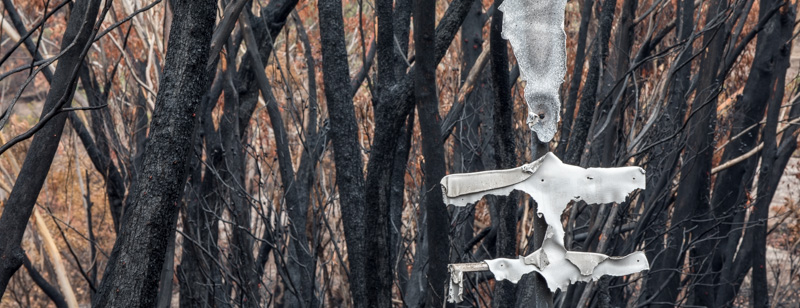
Twenty-five people including six firefighters died in NSW in the Black Summer bushfires, with 2448 houses destroyed, 5.5 million hectares burnt with the loss of large numbers of native wildlife and stock and $1.88 billion in insurance costs. More detail on the impacts can be found here.
The NSW Bushfires Coronial Inquiry is currently conducting a series of inquests and inquiries relating to the 2019-20 NSW bushfire season. The process is explained in the Coroner’s Public Hearings Information Paper.
Coronial proceedings commenced on 25 August 2021 and hearings are scheduled to continue to the end of May 2023. Stage 1 hearings considered deaths and 44 of the Black Summer fires, with many hearings held in the regions.
The Stage 2 hearings are examining case studies which represent major issues emerging from Stage 1. Topics heard in 2022 have included Public Warnings, Bushfire Investigations by the Rural Fire Service and Police, and Bushfire Risk Classifications. The 2023 Stage 2 hearings are on Vehicle Design and Safety, Fire Prediction Modelling and Backburning Operations – Planning and Execution. As at April 7, the only remaining topic to be heard is Backburning, with hearings scheduled for 15-26 May 2023. All hearings can be viewed live online or later on the Coroner’s youtube channel.

Systemic issues
Systemic concerns identified in the hearings include:
- Public Warnings – timing, accuracy and effectiveness
- Bushfire Investigations by Rural Fire Service and Police – distinguishing one fire from another, the naming of fires, which fires are investigated, who should do investigations and the quality of those investigations
- Vehicle Design and Safety – protection from rollovers and falling objects
- Fire Prediction Modelling – use and quality of predictions
- Backburning Operations – planning and execution (not yet heard)
Some of these concerns are connected. For instance, fire predictions inform public warnings and backburning. The Coroner has engaged independent expert witnesses to assist with examining some of these topics, and to help identify practical improvements.
IBG comment
- Any comment while the Coronial Inquiry is in progress must be limited and cautious.
- IBG has previously observed that the existing system of public and coronial inquiries, while producing useful outcomes and serving some other purposes, is not be the best way to examine bushfire operations and promote improvements. The IBG position is explained further in the IBG submission to the Select Committee on Coronial Jurisdiction in NSW.
- IBG has also urged the NSW government to establish an Inspector-General of Emergency Management (IGEM) for NSW as exists in Victoria and Queensland. The role would be expert and independent of combat agencies. It would design continuous learning processes and oversee their implementation. The IGEM would greatly assist the work of the Coroner.
- The way the current Coronial Inquiry is forensically examining some systemic issues is encouraging.
- The hearings into Bushfire Investigations (19-20 September 2022) highlighted issues with how fires are defined, which fires are investigated and which agency does the investigation. In one case of an escaped backburn, the police investigation was diverted to a location unrelated to the fire origin.
- Bushfire Warnings (21 and 23 September 2022) looked at examples where emergency warnings were not issued in time before communities were impacted by fire.
- The hearing into Vehicle Design and Safety (29 March 2023) involved independent expert witnesses in a productive three-way discussion about better protection of vehicle occupants. Some of those experts were already working with the Rural Fire Service to examine options and act on vehicle improvements. This is a commendable example of how an issue can be acknowledged and progressed collaboratively and with commitment. It is to be hoped that other systemic issues can be progressed in a similar way.
- The hearing into Fire Prediction Modelling (4 April 2023) explored the relative merits and accuracy of the several models in use, and some better alternatives being developed. The IBG was pleased to hear about the prospect of improved models and greater emphasis on atmospheric stability in fire behaviour prediction and backburning.
- IBG has a particular interest in the appropriate use of backburning, which is a vital option for controlling wildfires, yet risky and problem-prone. IBG’s 2020 report Reducing the Costs and Impacts of Bushfires and Fire Case Studies examined backburning issues in detail. The Coroner has been made aware of these IBG reports and studies. In response to the hearing on Bushfire Investigations, IBG wrote to the Coroner suggesting improvements to the way these are undertaken. IBG recommendations included:
- Significant (ie. strategic) backburns and those ignited some distance from the wildfire should be treated as new ignitions. Any ‘escaped’ backburn, of any scale or location, should also be treated as a new ignition, to trigger the investigation system.
- Any subsequent investigation should be managed at arm’s length with independent oversight (as in Police Critical Incidents).
- All bushfire investigations should be required to seek evidence and statements from all relevant participants.
- Oversight by an Inspector General of Emergency Management.

 Independent Bushfire Group