While the Coronial Inquiry into the 2019/2020 NSW Bushfires produced limited recommendations (see IBG post 8 April 2024), the body of the coroner’s report contains useful information. One item of interest is an ‘executive statement’ submitted to the coroner from the NSW National Parks and Wildlife Service (NPWS), which is reproduced in full in the coroner’s report (see Volume 2, Attachment B, pages 312-313). The NPWS statement raises three concerns arising from the fires of 2019-2020:
- Prioritisation of aircraft, particularly for rapid response to new ignitions
- Command and control of fires
- Investigation of fires
While the Rural Fire Service (RFS) is the lead bushfire agency in NSW, the Rural Fires Act 1997 recognises three other ‘fire fighting authorities’. These are NSW Fire and Rescue, OEH (NPWS) and NSW Forestry Corporation. These agencies cooperate in major fire emergencies, and each have their own specialties, strengths and weaknesses.
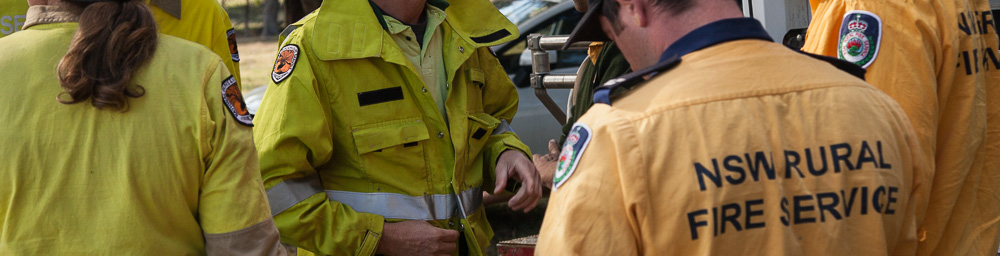
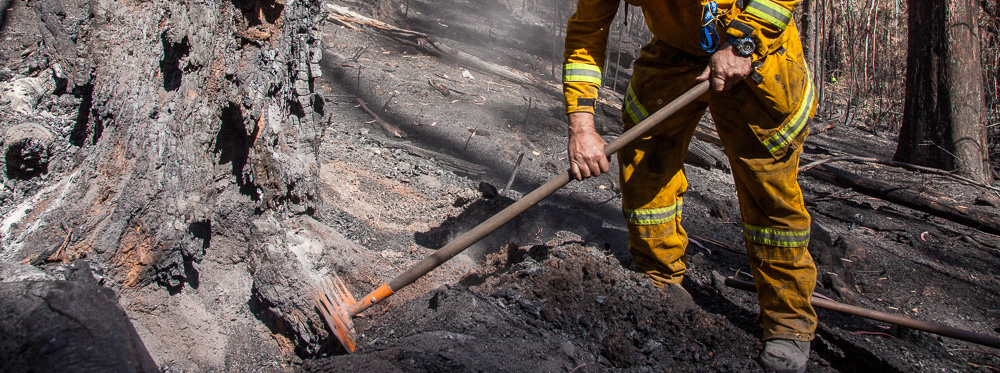
NPWS is usually responsible for first response and ongoing suppression (often with RFS) for bushfires that start on NPWS managed land (9.5% of NSW), and often assist with off-park fires. Advice from NPWS is that they have more than 1200 trained firefighters. Of these, 850 are qualified for RAFT (Remote Area Firefighting Teams). This is the largest paid bush fire fighter force in NSW, and also the largest RAFT force. RAFT is an NPWS specialty because of the extent of bushfire-prone land the agency manages that is only accessible on foot or by air. NPWS also runs several fire-equipped helicopters to transport firefighters, water-bomb and provide other support to bushfire response.
Much of the NPWS statement is repeated and reinforced in the coronial report, including this (Volume 2, page 283) on aircraft allocation:
“…during the 2019-2020 bushfire season, aircraft allocation to existing fires was prioritised over maintaining aircraft resources for response to new ignitions. Insufficient aircraft availability meant that the initial weight of attack was inadequate to prevent new ignitions from propagating and developing into large fires…Incident Management Teams responding to the new ignitions were unable to obtain appropriate air support to enable an effective initial response as aircraft were tasked elsewhere in the State on existing larger fires…As a result, initial attack was unsuccessful resulting in large fires with significant impacts on assets and NPWS parks.”

The NPWS statement cites the Gospers Mountain and Ruined Castle fires as examples, both in the Greater Blue Mountains. The NPWS statement (Coroner’s Report Volume 2, page 312) also says:
“At a statewide level, there did not appear to be clear criteria for prioritising, allocating and re-allocating aircraft to fires based on risk and initial attack. This issue was also raised during the NSW Bushfire Inquiry which included recommendations directed towards this issue.”
Elsewhere (Volume 2, page 14) the coroner’s report says:
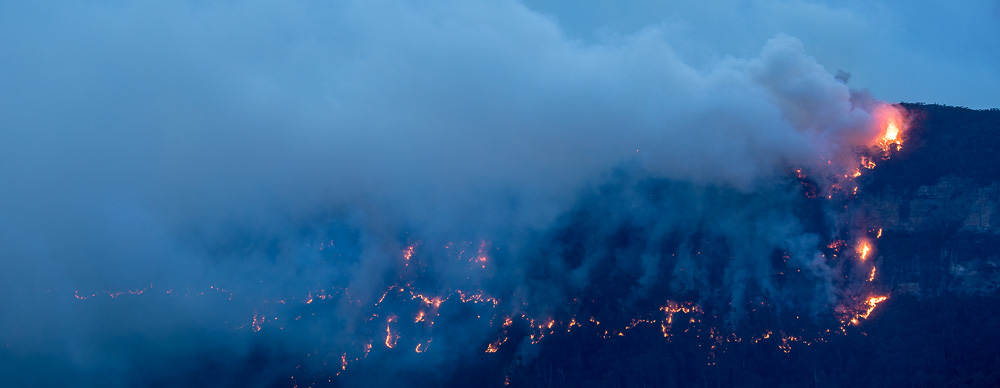
“…during the 2019-2020 bushfire season there were 41 ignitions (primarily as a result of lightning) across the Greater Blue Mountains World Heritage Area. Twenty of these remote ignitions were successfully contained by NPWS RAFTs to an average fire size of less than 1.2 hectares. All the fires were in remote and rugged terrain and the response involved highly trained and skilled crews winching in from helicopters.”
IBG comment
- This information from the coroner’s report confirms longstanding IBG concerns. Since its inception IBG has said that, based on analysis, many of the worst fires in Black Summer started as lighting strikes in remote bushland and could have been put out but were not. IBG has urged expansion of RAFT capacity and changed protocols to ensure new ignitions receive high priority for response and resources.
“Numerous ignitions were not attacked at all or were attacked inadequately. Many of these became disastrous fires some weeks later. The need to retain a rapid RAFT response, even when other fires are going, is critical to managing risks.”
(Reducing the Costs and Impacts of Bushfires, IBG July 2020)

- It is now widely recognised that putting new fires out quickly is critical to reducing the impact of bushfires. The NSW Bushfire Inquiry (2020), the Royal Commission Into National Natural Disaster Response (2021) and now the NSW Bushfires Coronial (2024) have all emphasised this principle. A small fire is a cheap fire and a less damaging fire.
- Since 2019-2020 the RFS has obtained two additional medium helicopters and NPWS has obtained one additional medium helicopter, all of which can do RAFT work. RAFT personnel have also increased in number, with NPWS provided with 200 additional positions to be RAFT-capable and RFS receiving additional fire mitigation teams. According to the coroner’s report, RFS has conducted trials on pre-positioning RAFT and aircraft for rapid response, and a predictive module for ignition potential has been embedded into fire management systems.
- However IBG remains concerned that these resource and procedural improvements have not been supported by changes in protocols and priority-setting, or in removing other barriers to rapid and adequate initial attack.
- Recommendation 45(b) from the NSW Bushfire Inquiry said: “…this may require prioritising the deployment of RART to enable rapid initial attack of new remote area ignitions over ongoing suppression operations, where supported by a relative risk assessment”. Inquiry Progress Reports cite this recommendation as “Complete” in 2021, despite no such protocol being reported.
- The coroner’s report subsequently pointed to the lack of a clear system for prioritising fires and aircraft in 2019-2020, but reported no action on this front.
- Despite these findings from two inquiries, IBG is not aware that any risk analysis system has been adopted. Priority setting remains opaque.
“Energetic attack is essential, but often the opposite occurs: under-reaction. Insufficient weight of attack is caused by too few aircraft and dedicated crews or because resources have been sent to other fires perceived to pose a greater risk.”
(Reducing the Costs and Impacts of Bushfires, IBG July 2020)

- Resources were stretched from very early on in Black Summer, and conditions were often very challenging. Still, many fires were put out when they were small, despite the prevailing conditions of severe drought which made suppression more difficult.
- Priorities should be based on a formal risk management system, as in so many other critical industries. This would include assessment of both the short term and long term threats and risks of fires. In a dangerous season such as Black Summer, IBG’s analysis suggests that new ignitions should often be prioritised above going fires. Otherwise big new fires keep coming with ever-expanding impacts and demands on firefighting resources.
- Focusing limited resources on new fires can be a rational and defensible decision even if it might risk increased damage from going fires. Risk assessment would be informed by factors such as forecast thunderstorms, especially if followed by a forecast of deteriorating fire weather.
- NSW needs dedicated fast remote response capacity that is always available when there is a risk of lightning ignitions.
- Every fire is different, and a range of factors would have played out in each fire in Black Summer and later seasons that “got away”. It is important that these factors are analysed from past fires so that they can be taken into account in risk management, resource deployment and priorities. This analysis is not being done.
A case study – initial attack on the Green Wattle Creek fire (2019)
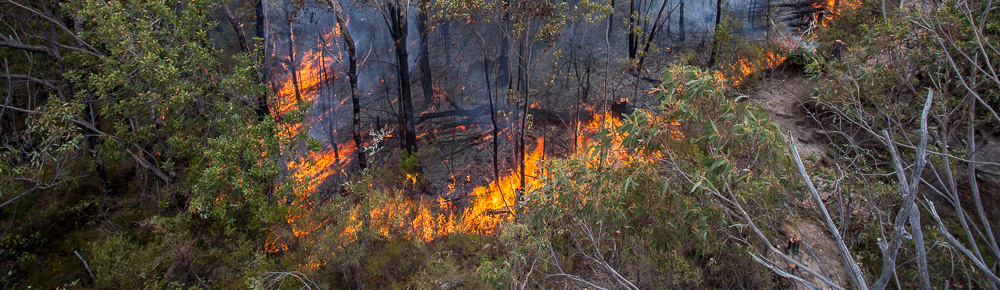
- In their coronial submission, NPWS nominated the Gospers Mountain and Ruined Castle fires as Black Summer lightning ignitions that could have been put out. Gospers Mountain became what has been described as Australia’a largest ever forest fire. IBG analysis has found other major fires that could have been put out. An example was Green Wattle Creek, a large and disastrous fire that led to two deaths.
- A chronology of the early stages of the Green Wattle Creek fire appears on pages 328-329 of Volume 1 the coroner’s report, and IBG has its own analysis. The same wave of thunderstorms, presumed to occur late on 26 November 2019, ignited Green Wattle and at least four other fires in the region: in the upper Kowmung River, on Kanangra Plateau (Thurat), at Butchers Creek and in the Blue Labyrinth (Red Ridge). The Thurat fire was close to vehicle access and was extinguished, but later overrun. No response was made to the Kowmung fire in very rugged terrain, and it eventually merged with the Green Wattle Creek fire.
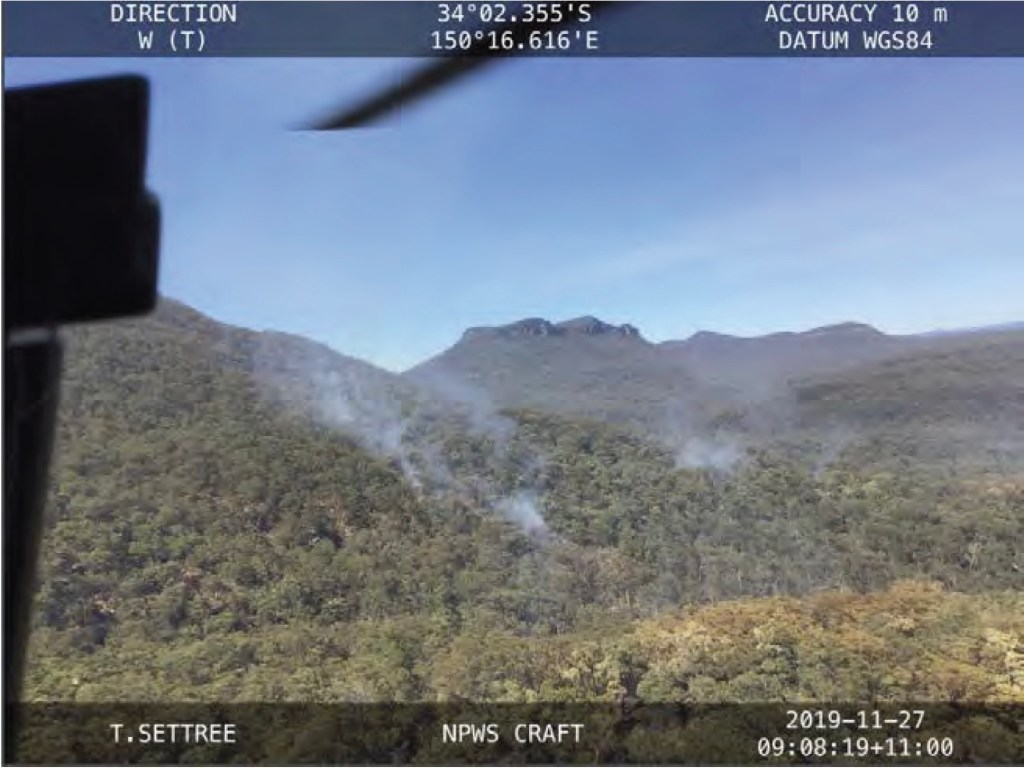
- Green Wattle Creek and Butchers Creek fires were separate ignitions close together. The first response to these fires was by an NPWS RAFT team who assessed the situation by helicopter at about 9.00 am on 27 November. A photo of the Green Wattle fire from this flight is reproduced on page 329 (Volume 1) of the coroner’s report. It shows a few puffs of smoke with “no flames visible”.
- Before they could take any action, the NPWS team was diverted to the Red Ridge fire, a priority due to its closer proximity to human assets. Red Ridge was one of at least 20 fires extinguished in the Blue Mountains national park system that season, but was later overrun by the Green Wattle Creek fire.
- The coroner’s report mentions aerial attack but without details. According to an NHRA research report (Investigating the suitability of aviation tracking data for use in bushfire suppression effectiveness), aerial attack did not commence until nearly three hours after the fires were detected. Several aerial strategies were attempted but failed to stop the spread of the fires. It is an accepted tenet of firefighting that aerial suppression cannot succeed without firefighters working on the ground.
- There was no ground response to Green Wattle until nearly six hours after the first reconnaissance, at 2.45 pm. The reasons for this hiatus remain unreported. By that stage both fires had escalated in the heat of the day. By then Green Wattle was too dangerous for ground attack, and attempted control of Butchers Creek soon failed.
- The two fires merged and continued to burn for about 11 weeks, destroying 37 homes and burning about 278,200 hectares, mostly within the Warragamba water catchment. Two firefighters died near Balmoral on 19 December after a backburn breakout.
- During the 2019-2020 summer, bushfire protection in the Warragamba Catchment was contracted out by WaterNSW, with a focus on rapid response. No response by the contracted Catchment RAFT (CRAFT) to the Green Wattle and Butchers Creek fires has been reported.
“…it is reasonable to consider whether all lightning fires could be contained if initial attack is both fast enough and large enough. To aspire to this aim, obstacles to success need to be removed.”
(Reducing the Costs and Impacts of Bushfires, IBG July 2020)
 Independent Bushfire Group