Two recent articles in The Conversation have reported on research looking at the role of fire in tall, wet forests, and ‘long unburnt’ vegetation.
In the first article, “Gone in a puff of smoke: 52,000 sq km of ‘long unburnt’ Australian habitat has vanished in 40 years“, four researchers describe their research showing how changing patterns of fire over the past 40 years have reduced the area of long unburnt bushland.
They say that areas that have ‘escaped’ fire for ‘decades or centuries’ are important for biodiversity because they ‘tend to harbour vital structures for wildlife, such as tree hollows and large logs’.
We found areas of long unburnt vegetation (30 years or more without fire) are shrinking. Meanwhile, areas of recently burnt vegetation (5 years or less since the most recent fire) are growing. And fires are burning more frequently.
The Conversation, 23 April, 2024
By analysing 40 years of fires on 21.5 million hectares of conservation reserves and state forests across southern Australia, they found that fires ‘are becoming more frequent in many of the areas most crucial for protecting threatened wildlife’. Long unburnt habitat is disappearing, putting many fire-threatened species at risk.
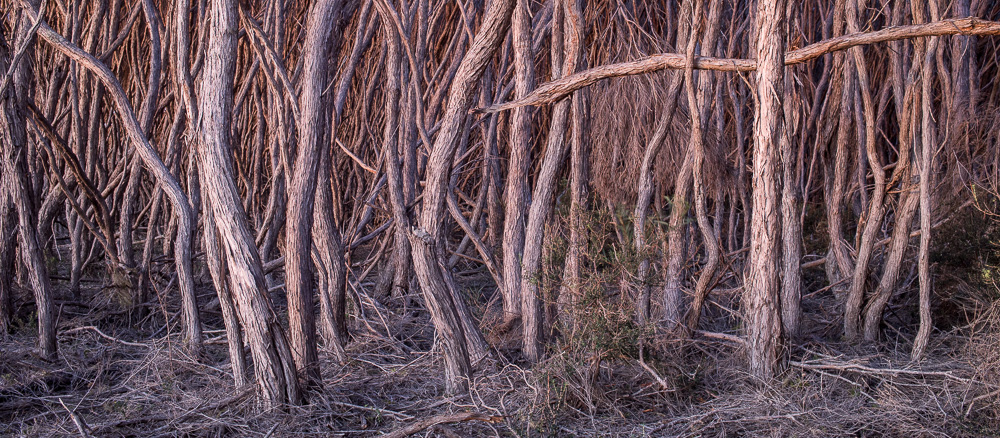
The second article “Our tall, wet forests were not open and park-like when colonists arrived – and we shouldn’t be burning them” challenges the view that these areas of forest should be kept ‘open’ through frequent burning.
This different group of four researchers looked at Indigenous and early colonial records of tall, wet forests in Victoria and analysed the scientific evidence. They conclude that ‘most areas of mainland mountain ash forests were likely to have been dense and wet at the time of British invasion’. Mountain Ash (Eucalyptus regnans), is the world’s tallest flowering plant and prominent in the tall, wet forests of Tasmania and Victoria.
“The ecological and other scientific evidence suggests mountain ash forests evolved under conditions where high-severity bushfires were rare…these forests were not open or park-like – as was the case in some other vegetation types in Australia”
The Conversation, 24 April 2024
The researchers point out that Aboriginal traditional knowledge recognises ‘Country that needs fire, and Country that doesn’t need fire’. They write that repeated fire is ‘unsuited to the ecology of tall, wet forests’, that it will ‘destroy habitat for a wide range of species’ and could lead to ‘collapse and replacement by entirely different vegetation such as wattle scrub’.

IBG comment
- These research reports contribute to the ongoing discussion about the diverse role of fire in the Australian environment and how fire can be managed with biodiversity conservation in mind.
- The research also highlights that fire regimes are complex at all scales and specific to particular places. Fire management needs to respond to these variations. Generalisations across broad landscapes are unhelpful.
 Independent Bushfire Group