How effective is aerial firefighting?

In January 2023 the Bushfire and Natural Hazards Cooperative Research Centre (BNHCRC) released a tranche of reports related to the Black Summer fires (2019-2020). One of these was Investigating the suitability of aviation tracking data for use in bushfire suppression effectiveness research. Researchers from the University of Wollongong, CSIRO and the BNHCRC analysed the airdrop data available from NSW and crunched it various ways to see how useful it was and what they could extract from the data about effectiveness. This proved difficult.

The authors list the multiple inquiries that have called for research into the effectiveness of firefighting aircraft – a research blind spot. The BNHCRC report adopted terminology from a pioneer US project on Aerial Firefighting Use and Effectiveness, which was prompted by ongoing US government frustration over the cost of aerial firefighting and the lack of evaluation. To assess the effectiveness of aerial drops, the US project used five objectives (eg. initial attack, property protection) and seven outcomes (eg. the drop delayed fire spread, protected assets successfully). However the nine-year, $US11 million project produced limited results.

Location tracking is mandated for all Australian firefighting aircraft, but only some are required to have firebombing event logging (drops and fills etc.). NSW data was lacking in many parameters:

  • 60% of specialised bombing aircraft had no drop data, including at least two LATs, one being the RFS 737;
  • 63 of 64 smaller aircraft (including 48 firebirds) also had no drop data;
  • the actual drop product used (water, gel, foam, retardant) was missing in 70% of cases;
  • drop volume was missing in 44% of cases;
  • drop objectives were often not recorded.

Firebombing aircraft include large and medium helicopters, single engine air tankers (SEATs) and large air tankers (LATs).) To overcome some of the data shortfall, 10 experienced Air Attack Supervisors (AAS) from the NSW Rural Fire Service, NSW National Parks and Wildlife Service and British Columbia Wildfire Service were interviewed about specific Black Summer fire events they worked on in NSW. They were also asked: “What improvements could be made to data gathering or the reporting systems to improve our ability to learn” (page 35). They had many ideas and all supported a routine interview or survey of AAS after future bushfires.

The report includes eight case studies of “particular days at a particular part of a fire”, using both recorded data and information from interviewees. The case studies provide examples where aerial bombing was deemed effective, ineffective or inconclusive. The report emphasises that in the absence of information about on-ground activity and many other factors, assessing outcomes is problematic.
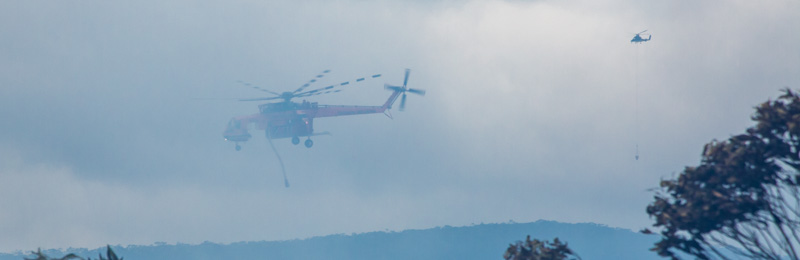
The paper also cites the cost of NSW aerial firefighting in Black Summer, which was $306.3 million. This included six LATs and VLATs (very large air tankers) dropping 24 million litres on 1708 missions (NSW Rural Fire Service, Royal Commission Into National Natural Disaster Arrangements, Notice & Summons to Give information NTG-HB2-209, pages 20-21).

The BNHCRC report found that: “…this data has the potential to facilitate comprehensive analyses of aerial firefighting effectiveness that were not previously possible. This work explored methods and case studies that could be expanded into comprehensive evaluation” (page 54). However the missing data “hamper learning and needs to be improved”.

The authors make a number of recommendations, including (page 55):

There should be a routine interview or survey process for AAS after the bushfires…aimed at identifying objectives and outcomes”.

Fire management agencies should create an evaluation database that summarises objectives, outcomes, the number and type of aircraft, drops, type and litres, and ancillary observations such as weather, resources available etc“.

The next step would be to investigate the conditions associated with success or failure, including weather, size and behaviour of the fire, scale of the objective, amount of resources available, drop quantity and type etc. Ultimately, there should be research that examines the full context of aerial suppression, which includes how effective it is when combined with other types and amounts of suppression…”

(Investigating the suitability of aviation tracking data for use in bushfire suppression effectiveness research, page 55)

IBG comment

  • This report yet again highlights the dearth and critical need for more bushfire suppression analysis and research, especially on firefighting strategies and effectiveness. This is a core focus for IBG’s work.
  • The lack of adequate data on which to base analysis indicates a longstanding disinterest by fire agencies in learning from past operations, and a tragic lost opportunity from the important lessons that should have come out of Black Summer. There is little evidence that this situation is improving. IBG asserts NSW needs an independent Inspector General of Emergency Management to drive learning culture.
  • Aerial operations are an essential and important part of bushfire suppression. But the massive cost is not matched by the evidence base to understand what works best and what doesn’t, especially for bombing work. Aircraft continue to be purchased and contracted without evaluation of the best mix of aircraft and the best use for each type of aircraft.
  • The BNHCRC report recommendations and “next step” (quoted above) are strongly supported as essential to optimising the use of firefighting aircraft to reduce bushfire impacts.

“When a [US] federal agency spends more than half a billion dollars in a year on one activity such as fire aviation with very little meaningful oversight, it needs to have a robust knowledge base for making decisions about how to spend those taxpayer dollars.”

 “In conditions like we have seen in recent decades, fire agencies, including those who mostly grow trees, should be extremely confident their aerial fleets are comprised of the most capable aircraft in adequate numbers so that all wildland fires that are being suppressed can be attacked from the air within the first 20 minutes, supporting firefighters on the ground. This is just basic Homeland Security.”

Bill Gabbert, writing in Fire Aviation (US online magazine), April 16 2021, on “What did we learn from the Aerial Firefighting Use and Effectiveness study?

Emergency leaders report on grass fire threat

A report from the Climate Council and Emergency Leaders for Climate Action (ELCA) has highlighted the emerging threat of grass fires after the rains of the past few years.

Powder keg: Australia primed to burn (February 2023) points out that grass growth has been prolific, so major grass fires are likely as we move into a drier period (as climate models forecast).

The report calls for governments to “prepare for a dangerous fire season later in 2023“, through increased funding, more staff and volunteers, permanent disaster recovery arrangements, more funds for community resilience and stronger emission cuts.

An opinion piece from lead report author Greg Mullins highlights the danger of fast-moving grass fires, and some history of previous extensive grass fires.

IBG comment

  • Recent large fires in the NSW ‘grass belt’ point to an emerging threat later this year.
  • IBG asserts that not enough has changed in NSW fire management systems to prevent similar outcomes in the future as happened in Black Summer. Hence IBG supports ELCA’s call for more investment and preparation in critical areas. It is also vital that investment is based on evidence, well targeted and assessed for effectiveness.

Black Summer bushfire research

In January 2023 the Bushfire and Natural Hazards Cooperative Research Centre (BNHCRC) released a tranche of reports on research emerging from the Black Summer fires of 2019-2020.

The CRC received $2 million from the Australian Government to explore immediate issues arising from the fires. The CRC and partner agencies also allocated funds for more specific research projects. The research was based on the main issues identified in various inquiries, and grouped into four broad themes: fire predictive services, cultural land management, community-centred disaster risk reduction and bushfire data and reconstruction.

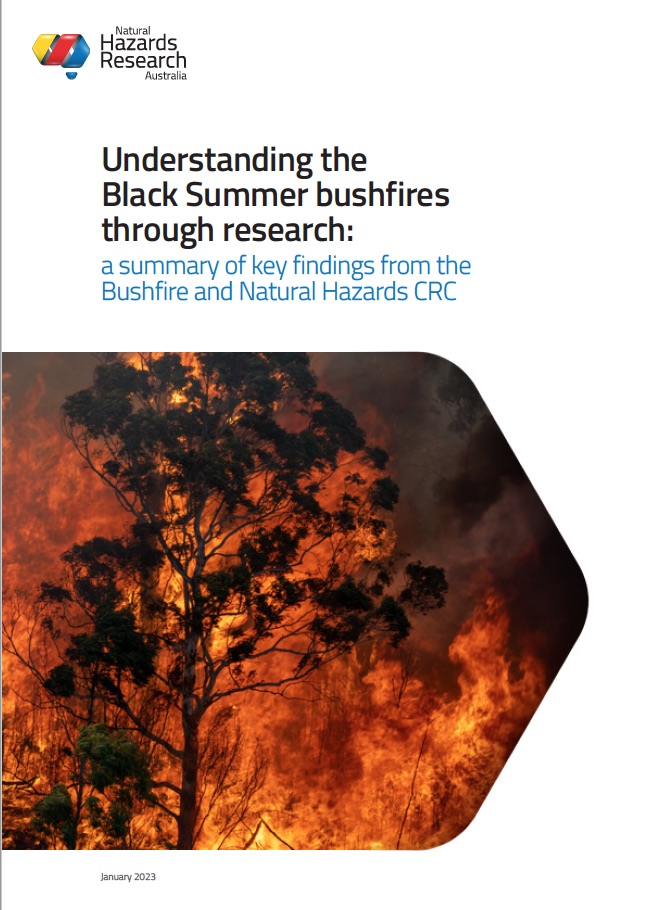
The summary report (Understanding the Black Summer bushfires through research: a summary of key findings from the Bushfire and Natural Hazards CRC), outlines the 22 projects carried out under the CRC ‘umbrella’ and the four themes. Topics range widely from community recovery, prescribed burn effectiveness, fuel moisture, cultural land management and risk modelling to case studies and reconstructions of particular fires.

The various reports as well as the summary can be found here.

IBG comment

  • IBG advocates for a rapid expansion of bushfire research, so this collection is a welcome addition.
  • The funds allocated to solving critical questions in bushfire management are very small compared to what is spent on bushfire mitigation, suppression and recovery.
  • With a focus on operational improvement, IBG is particularly interested in the projects on aerial firefighting, bushfire predictions, weather and fire reconstructions/analysis. However some of these studies deliver less than expected, with either a narrow focus or discovering that data was not adequate to support more useful findings. This highlights both the lack of historical support for data and research, and the preliminary nature of much bushfire research. Much more work needs to be done if the impacts of future severe fires are to be reduced.
  • In subsequent posts IBG will progressively review some of the more interesting reports from this BNHCRC collection.

Audit Office report on fire fighting equipment management

A recent report from the NSW Auditor-Generalassessed the effectiveness of the NSW Rural Fire Service (RFS) and local councils in planning and managing equipment for bushfire prevention, mitigation, and suppression.” The report focused mainly on the RFS fire fighting fleet, which comprises land vehicles, marine craft and aircraft, all of which are integral to the agency’s overall bushfire risk management.

The report, released on 27 February 2023, notes the confusion of roles between the RFS and local government for the maintenance of certain land-based fleet and that, despite this being raised in local government audits over several years, has not been resolved by legislative amendment. This puts at risk the readiness of the fleet when a fire starts.

The report also notes the substantial progress made by the RFS in modernising its firefighting fleet and making it safer for fire fighters. The report states that the average age of fire fleet has been reduced from 21 years in 2017 to 16 years in 2022 but remains short of the target average age of 15 years.

The report observes that the RFS could not demonstrate a strategic process for acquisition of aviation fleet and early detection technologies to deliver their target of smaller fires, which is to limit 80% of fires to under 10ha in size.

The Audit Office’s highlights summary describes the main concerns under What we found:

  • The RFS has focused its fleet development activity on modernising and improving the safety of its firefighting fleet, and on the purchase of new firefighting aircraft.
  • There is limited evidence that the RFS has undertaken strategic fleet planning or assessment of the capability of the firefighting fleet to respond to current bushfire events or emerging fire risks.
  • The RFS does not have an overarching strategy to guide its planning, procurement, or distribution of the firefighting fleet.
  • The RFS does not have effective oversight of fleet maintenance activity across the State, and is not ensuring the accuracy of District Service Agreements with local councils, where maintenance responsibilities are described.

The report goes on to make a number of recommendations to address these issues and improve fleet strategy, assessment, use and maintenance.

IBG comment

  • IBG welcomes the modernisation of the RFS firefighting fleet, and the resultant improved safety for fire fighters.
  • The lack of a strategic approach to fleet planning, procurement and distribution is concerning, particularly in relation to aircraft. Just as in the military, the composition of the firefighting fleet should follow a strategy based on identified needs and risks.
  • IBG has long argued for stronger first response and suppression capability to keep fires small, especially fires remote from vehicle access. Historically, the emphasis for fire fighting resources has been on road-based capability and strategies. Black Summer and previous fire seasons have shown that more emphasis is needed on aerial attack and remote fires.
  • Recent aircraft acquisitions (since Black Summer) have included several helicopters, a large air tanker and other fixed-wing aircraft, at substantial cost. While these may be useful for specific purposes, there is no analysis to demonstrate that the aircraft fleet has the best and most cost-efficient mix for current and future fire risks.
  • The 2020 Royal Commission into National Natural Disaster Arrangements noted that independent accountability was important to encourage the best use of resources and the best possible outcomes for communities and firefighters. IBG continues to advocate for an Independent Inspector General for Emergency Management for NSW, as exists in Victoria and Queensland.
  • IBG issued a media release on these issues.

Problems with Bushfire Recovery grants

On 2 February 2023 the NSW Auditor-General released a report critical of the the administration of the first round of Bushfire Recovery grants in 2020. The total Bushfire Local Recovery Grant (BLER) scheme program amounted to $541.8 million, co-funded by the Commonwealth and NSW governments and administered by the NSW Department of Regional NSW.

The Auditor-General found that:

The Department of Regional NSW did not effectively administer the Fast-Tracked stream of the BLER.

The administration process lacked integrity, given it did not have sufficiently detailed guidelines and the assessment process for projects lacked transparency and consistency.

At the request of the Deputy Premier’s office, a $1 million threshold was applied, below which projects were not approved for funding. The department advises that some of the projects excluded were subsequently funded from other programs.

This threshold resulted in a number of shortlisted projects in areas highly impacted by the bushfires being excluded, including all shortlisted projects located in Labor Party-held electorates.”

Some of the fire-impacted areas that missed out in the first round received grants in the second round, some nine months later.

The report received widespread media and political coverage and comment. Both the government and opposition have responded with promises to improve processes so the ‘pork-barrelling’ of community grants cannot happen again.

IBG comment

  • Its disturbing that grants to traumatised and struggling communities could be politicised, but sadly unsurprising.
  • All grant programs should be transparent and honest, with the Auditor General’s recommendations adopted in full.
  • The NSW Audit Office plays an essential role in keeping the government honest. It is hoped other areas of bushfire expenditure will be examined to ensure the best outcomes are being achieved.
  • It is noted that Resilience NSW was involved in setting up the BLER program. That agency is now abolished and the new Reconstruction Authority does not replace all functions. The IBG asserts that NSW needs an Inspector General of Emergency Management to provide independent oversight of emergency management and recovery, as in Victoria and Queensland.
  • IBG issued a media release commenting on these issues, and has submitted a proposal for an Inspector General of Emergency Management to a range of government, opposition and cross-bench politicians, which can be found here.

Better backburning & fire danger ratings

Early in 2021 the Rural Fire Service (RFS) responded to a recommendation (no. 47) from the NSW Bushfire Inquiry and introduced a new protocol for backburning. Known as OP 1.2.20 Operational Protocol for Backburning, the document supercedes “SOP #17” of 1999 and includes much more detail on types of backburns, risks, approval and recording. Notably it requires higher-level review of strategic backburn proposals under certain risk conditions.

In a more recent advance, also related to to a NSW Bushfire Inquiry recommendation, a new Australian Fire Danger Rating System (AFDR) has been developed nationally and will be rolled out across Australia from September 2022. The new system has just four ratings instead of six and applies to eight different vegetation types rather than just forest and grassland previously. In NSW the rollout will be accompanied by a community education campaign.

Image: NSW Rural Fire Service

The new system delivers simplified public communication, while applying a more nuanced science of fire danger to better inform firefighters. This includes a complex of meteorological factors, which can be ‘decoded’ on the ground to inform decision-making. Notably, the AFDRS incorporates ‘red flag’ warnings for elevated Continuous Haines index (a measure of atmospheric instability) and for high levels of a new Wind Change Danger Index. A suite of technical guides support the system.

IBG comment

  • These advances will help bushfire management teams to make well-considered decisions in situations that are often complex and high-stress. The new Backburning OP and the new fire danger rating system will also aid community awareness and understanding.
  • The new Backburning OP is a major step up from the previous version that was in use for 20 years, despite revealing its weaknesses many times, up to and including Black Summer. The new OP addresses some key concerns documented by IBG in its report and submission to the NSW Bushfire Inquiry while leaving other issues unresolved. The risk threshhold for review of backburns should be lower. However the OP does promote much improved backburn planning. To ensure this is delivered it needs to be promulgated and applied throughout the bushfire industry, and not only within RFS. It is not clear if a process exists to assess the effectiveness of the new OP, but the relatively quiet fire season of 2021-22 has not yet provided a useful testing ground.
  • The new AFDR system includes detailed fire weather advice that will be routinely conveyed to bushfire suppression teams. This has the potential to be a catalyst for elevating suppression decisions and strategies. It could in future avoid some of the issues that were apparent in Black Summer, by promoting full consideration of factors such as atmospheric instability and the probability of wind changes.

No bushfire changes from coronial review

The report of the NSW Parliament’s Select Committee on the coronial jurisdiction in NSW was tabled on 29 April 2022. The committee carried out a review of the existing coronial system. Coronial legislation requires the coroner to investigate “certain deaths” as well as “fires and explosions that destroy or damage property”. When deaths occur in bushfires, such as in the Black Summer fires of 2019-2020, these purposes overlap.

The Select Committee report quotes on page 35 from the IBG submission, about the untimeliness of bushfire coronial findings. The report does not appear to have taken up other IBG concerns and includes no fire-specific recommendations.

The NSW Government is due to respond to the report by the end of October.

IBG comment

  • For bushfires, the coronial system is slow and unwieldy, but is public and independent. In this respect coronials remain the primary mechanism for objective investigation of bushfires in NSW, even though limited to those that cause death and property damage (note environmental assets are not legally relevant).
  • The Select Committee recommendations, if adopted, can strengthen and improve coronial processes, including for coronial inquiries related to bushfires.
  • Coronial investigations have the capacity to be thorough and rigorous and to deliver important findings. However they can also cause delays in improvements and public scrutiny when government agencies defer inquiry and comment and decide against releasing documents in deference to a coronial process. Even the NSW Bushfire Inquiry was careful not to impinge upon coronial processes.
  • Documents which have been refused to the public but which were available to the NSW Bushfire Inquiry include a report on the number of escaped backburns in 2019-2020 and an investigation into the Mt Wilson backburn escape. Aerial images of the fires were also refused until the Coroner authorised their release.
  • The IBG submission to the Select Committee argued that coronial investigations should not be seen as a replacement for more timely and routine operational reviews, nor used as a reason to avoid them. Expertise, independence and timeliness are critical to an effective lessons management system, and such a system should operate routinely and independently of any subsequent coronial. This principle is supported by Lessons Management Handbook from the the Australian Institute for Disaster Resilience (an Australian Government agency).
  • The current NSW bushfires coronial inquiry into the fires of 2019-2020 commenced in August 2021 with hearings scheduled to continue until March 2023. Findings will not be delivered until some time after that, and at least three full fire seasons after the event.
  • Bushfires are complex phenomena, where the ’cause and origin’ may not be very relevant to subsequent property damage or deaths which can occur months later. Numerous events, actions and non-actions along the way affect the final outcomes. It remains to be seen how well the NSW bushfires coronial can navigate these complexities to determine the ’cause and origin’ of impacts on towns like Wytalibah, Balmoral and Conjola Park…or indeed whether that is part of what the coronial inquiry will do.

Boost to National Park fire management

In another 12 June pre-budget announcement (see previous post), and in further response to the NSW Bushfire Inquiry, the NSW Government committed $598 million over 10 years to the National Parks and Wildlife Service (NPWS) to “bolster firefighting capabilities, improve radio networks and enhance the protection of significant habitats like the world-famous Wollemi pines”.

Remote area firefighters mopping up, Wollemi National Park

The money also funds 200 permanent national park firefighters and 50 conservation staff. The firefighters were previously temporary, and the conservation staff will give effect to the government’s earlier move to declare and protect “assets of intergenerational significance” (AIS) as a part of bushfire management.

Helicopters are critical to RAF operations (Wollemi National Park, 2013)

IBG Comment

  • This announcement recognises some important issues: that critical environmental assets deserve protection during bushfires, that land management agencies are crucial actors in bushfire management and that NPWS in particular manages most of the bushfire-prone bushland in NSW. The Rural Fire Service (RFS) is not a land manager but works cooperatively with government and private land owners to achieve bushfire outcomes.
  • IBG has long stressed the importance of rapid suppression of remote fires and has argued for more resources to support this objective and related capacities such as aerial attack and off-road suppression. Most of the large fires of Black Summer began as remote lighting strikes in national parks and other bushland, some of which could have been put out early with different strategies and appropriate resources.
  • These issues were a focus of IBG’s major report and submission to the NSW Bushfire Inquiry, Reducing the Costs and Impacts of Bushfires. The report highlighted an imbalance, where Remote Area Fire (RAF) operations have been under-valued and under-resourced compared to road-based capacity, ie. trucks, with tragic consequences. For managing wildfires in large bushland areas, this imbalance is akin to funding lots of ambulances while failing to adequately support doctors.
  • Because of the areas it manages, NPWS specialises in RAF and has the largest capacity in NSW (eg. 1200 firefighters, paid and mostly RAF-capable), and together with partner agencies such as RFS, a strong record of putting fires out when small (eg. at least 14 remote lightning strikes put out at a size of less than 4 hectares in Blue Mountains national parks during Black Summer) and also applying successful control strategies away from truck access (eg. see IBG Fire Case Studies 6 and 10). IBG commends that this funding boost will augment and expand these vital capabilities, especially the number of RAF firefighters. But more is needed.
  • As for protecting AIS, IBG has previously noted the difficulty of achieving this in wildfire scenarios (see IBG Post below of September 10, 2021). It is to be hoped that the provision of dedicated staff will help break down barriers in research, planning, knowledge and attitude.
  • $598 million is a lot of money. ‘Throwing money at a problem’ is often criticised, when the main barriers to progress can be policy, institutional, inertia and attitudes. Funding can be wasted, so monitoring, reporting and vigilance are required to ensure that real outcomes are actually achieved by such significant investments.

Bushfire budget announcement

On 12 June the NSW Government used the opportunity of the imminent state budget to announce how much it was putting into bushfire management. The 2022-23 budget will commit another $315.2 million over the next four years to “complete the recommendations of the NSW Bushfire Inquiry“.

The NSW Government announcement says it has previously committed $516.4 million to addressing recommendations from the Bushfire Inquiry. The government accepted the 76 recommendations and say that all recommendations are now complete or in progress.

At about the same time the latest quarterly NSW Bushfire Inquiry Progress Report was released, for the period January to March 2022. It lists 27 recommendations as completed, with the remainder being either fully or partly ‘in progress’. Action on many recommendations is complex and ongoing.

IBG comment

  • The government is to be commended for committing to all the Bushfire Inquiry recommendations, and for funding, pursuing and reporting on their completion.
  • Much good work has been done, and IBG is particularly pleased to see progress in important operational areas such as bushfire research, firefighter safety, ecosystem management, the Fires Near Me app, night-time firefighting, divisional commanders, rapid aerial suppression, use of heavy plant and assessment of risk mitigation programs.
  • In some cases the actions and progress listed in the progress report interpret the recommendations either narrowly or differently to what was intended, or overlook parts of the recommendation, eg. recommendations 8, 20, 24, 28. The highly dubious Rural Boundary Clearing Code was justified as a response to recommendation 28. IBG has previously questioned the value of this initiative (see below IBG’s Post of September 14 2021).
  • IBG has previously commented that the progress reports lack measures of success, ie. actions are not outcomes, so how well are the actions working to achieve what was intended? Most inquiry recommendations were couched with outcomes in mind: “That in order to ensure…”, “that in order to improve…”
  • IBG continues to advocate for an independent Inspector-General of Emergency Management to ensure continuous operational improvement, and a NSW Bushfire Strategy that would tie the disparate actions into a comprehensive framework with clear targets and accountable outcomes (also see below IBG Post of August 24 2021).

Coronial Jurisdiction in NSW being reviewed

A Select Committee of the NSW Parliament is carrying out a review of the existing coronial system, which holds inquiries into unexplained deaths, damaging bushfires and some other matters.

The Select Committee is reporting on the scope and limits of coronial jurisdiction, resources, timeliness and appropriate changes.

There are concerns about these matters and how coronial processes can be more effective. Many authoritative submissions to the Select Committee have called for a standalone court.

IBG’s submission to the Select Committee is the only one of 48 submissions received that specifically focused on bushfires. IBG was subsequently invited to appear before the committee on 30 November 2021. IBG presented an Opening Statement and answered questions from the committee. IBG’s session can be seen on the NSW Government’s YouTube channel.

Under the Coroners Act 2009, the coroner has “jurisdiction to hold an inquiry concerning the cause and origin of a fire or explosion if the coroner is satisfied that the fire or explosion has destroyed or damaged any property…”. Fire includes bushfires, and inquiries can “extend to the examination of all of the circumstances concerning the fire or explosion (including, but not limited to, an examination of its cause and origin)“.

The NSW Coroner has held inquiries into a number of major bushfires, most recently the Sir Ivan Dougherty Drive Leadville fire of 2017 and the 2013 Wambelong fire. These have delivered some good if limited findings and recommendations but more than two years after the events.

The coroner is presently conducting a lengthy inquiry into the Black Summer bushfires of 2019-2020. Stage 1 public hearings are expected to conclude in mid 2022, to be followed by Stage 2 hearings which will focus on “selected case studies, any expert evidence and recommendations“.

IBG comment

  • IBG has long called for more effective, expert, timely and most of all independent processes for reviewing bushfires. While coronial inquiries are independent, they lack specific expertise, can only investigate damaging events and are very slow to deliver. Other processes including internal agency reviews and special inquiries (eg. 2021 NSW Independent Bushfire Inquiry) also have serious drawbacks.
  • IBG advocates for an independent Inspector-General of Emergency Management, which would be able to conduct independent reviews of both successful and damaging bushfire operations in an expert and blame-free process. These could promptly deliver important lessons for fire fighters and managers and feed into any necessary coronial processes.
  • As a starting point, any effective review would need to be based on a factual and technical analysis of what happened in a fire, to establish a common understanding for discussion.
  • There are many good models of this sort of review system. Other similar government functions in Australia have long had independent oversight, including the police, the military, transport and security agencies.